
Miami-Dade County Property Tax Records
Miami-Dade County property tax records are public documents covering more than one million parcels in Florida's most populous county. The Property Appraiser and Tax Collector each maintain separate sets of records tied to every parcel in the county, from single-family homes in Hialeah to high-rise condominiums along Brickell Avenue. This page explains how those records are organized, where to find them, and what they contain.
Miami-Dade County Quick Facts
Miami-Dade Property Appraiser Office
The Miami-Dade County Property Appraiser operates from the Stephen P. Clark Center at 111 NW 1st Street, Suite 710, Miami, FL 33128. The main phone number is 305-375-4712, and you can also reach the office by fax at 305-375-4070 or by email at pa@miamidade.gov. Office hours run Monday through Friday, 8 a.m. to 5 p.m. The appraiser's job is to set the assessed value of every parcel in the county as of January 1 each year. That value drives the annual tax bill, though the appraiser does not set millage rates or collect taxes.
Miami-Dade has one of the largest property rolls in the United States. The county includes over 30 municipalities plus large unincorporated areas, so the appraiser's office manages an enormous volume of data. The official property roll contains each parcel's legal description, owner of record, taxable value, assessed value, and any exemptions applied. Values change as sales happen, permits are pulled, and improvements are made. The appraiser uses mass appraisal methods aligned with Florida Department of Revenue standards, relying on comparable sales and property characteristics rather than inspecting each parcel individually every year.
You can search parcel records at the Miami-Dade Property Appraiser website or through the main county portal at miamidade.gov/pa. Both portals let you search by parcel ID, owner name, or address. Results show assessed values, prior-year data, exemption status, sales history, and aerial imagery.
The Miami-Dade Property Appraiser's official site is the primary source for parcel lookups in the county.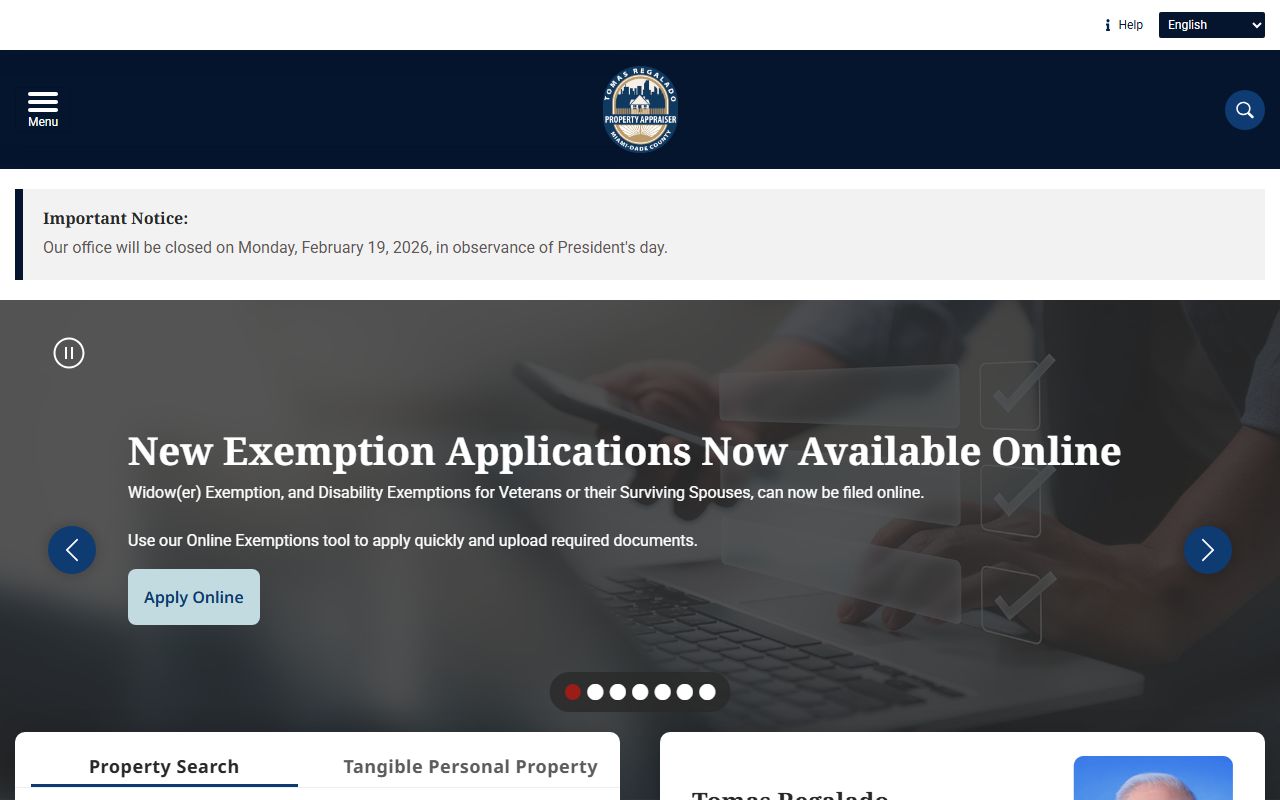
The search tool on the appraiser's site covers all parcel types across Miami-Dade's 35 municipalities and unincorporated areas.
Under Chapter 193, Florida Statutes, all county property appraisers must assess property at just value each year. Miami-Dade follows that standard and submits its tax roll to the Department of Revenue for review.
The appraiser's office also provides guidance on the TRIM (Truth in Millage) notice, which property owners receive each August. The TRIM notice shows the proposed assessed value, applicable exemptions, and estimated taxes from each taxing authority. It is not a bill, but it is your first look at what you will owe when the tax bill arrives in November.
The Miami-Dade county portal also links to appraiser services, tax collector payment tools, and exemption applications.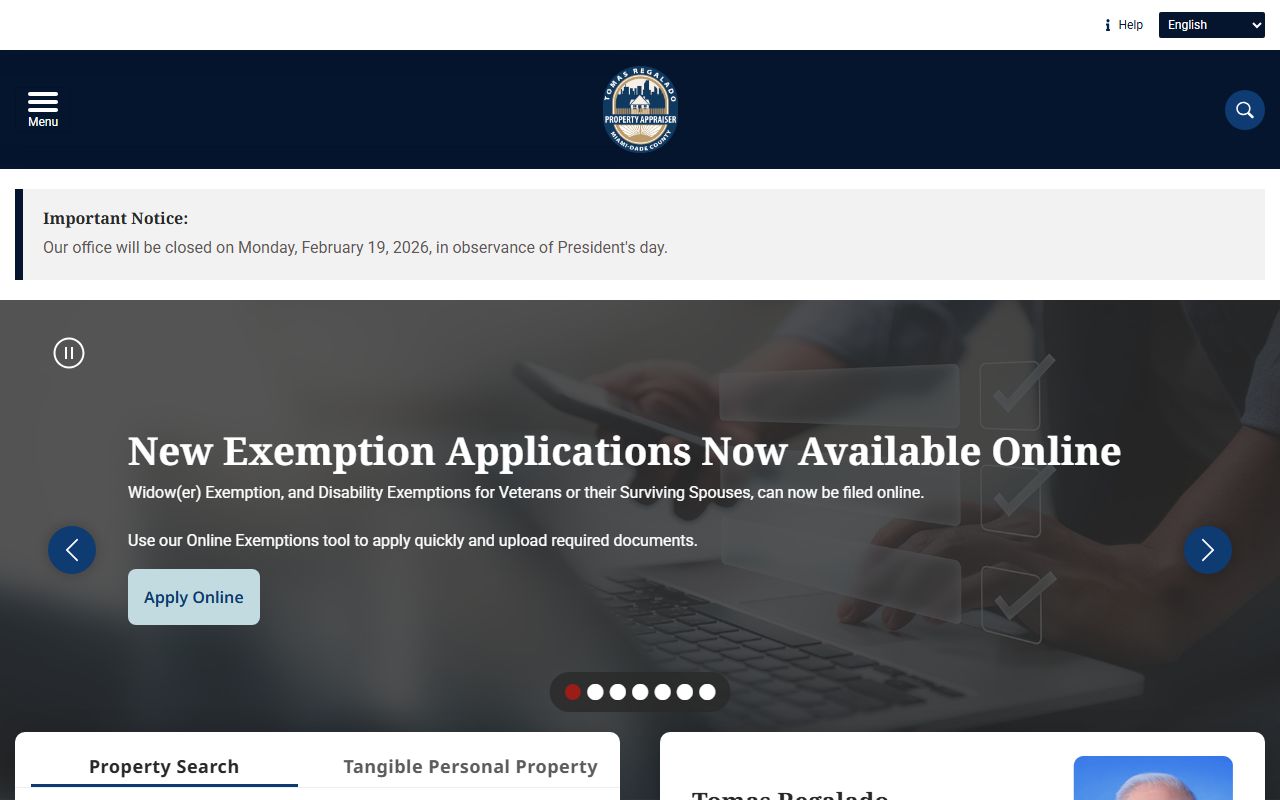
Both portals link to the same underlying parcel database maintained by the appraiser's office.
Homestead Exemption and Other Exemptions
Florida's homestead exemption removes up to $50,000 from the assessed value of a primary residence for tax purposes. The first $25,000 applies to all taxing authorities. The second $25,000 applies only to non-school levies. To claim the exemption in Miami-Dade, you must file with the Property Appraiser by March 1 of the tax year. You can file online at the appraiser's website, by mail, or in person at the Stephen P. Clark Center. Late filing is allowed in some cases, but it is better to meet the March 1 deadline.
Once you have homestead, the Save Our Homes (SOH) cap limits how much your assessed value can rise each year. The cap is the lesser of 3% or the change in the Consumer Price Index. In a county like Miami-Dade where real estate values have climbed sharply over the past decade, the SOH cap can mean a significant difference between your assessed value and the actual market value of your home. That gap is called the SOH benefit and it stays with the property as long as you hold homestead status.
Other exemptions include a $500 reduction for widows and widowers, a $500 exemption for persons with total and permanent disabilities, and full exemptions for certain veterans and surviving spouses of first responders killed in the line of duty. Senior citizens who meet income limits may qualify for an additional exemption on county and city levies. The appraiser's office can walk you through the forms and eligibility rules for each of these. Exemption rules are set out in Chapter 196, Florida Statutes.
Portability is another feature Miami-Dade homeowners often use. If you sell a home with an SOH benefit and buy a new one in Florida, you can transfer up to $500,000 of that accumulated benefit to the new home. This can reduce the assessed value on your new purchase substantially. You must apply for portability when you file for homestead on the new property.
Tax Bills and Payment Options
The Miami-Dade Tax Collector is located at 200 NW 2nd Avenue, Miami, FL 33128. The phone number is (305) 375-5570 and the fax is (305) 375-2871. The tax collector does not set values or rates. The office handles billing, payment processing, and enforcement once the tax roll is certified by the appraiser and millage rates are set by local governing bodies.
Tax bills go out in November. Miami-Dade offers the same early-payment discounts as the rest of Florida: 4% in November, 3% in December, 2% in January, and 1% in February. Pay on time or early to save money. Taxes not paid by April 1 become delinquent. At that point, the tax collector can move forward with a tax certificate sale. Investors bid on certificates, and if the property owner does not redeem the certificate within two years, a tax deed application can follow. The full process is governed by Chapter 197, Florida Statutes.
Miami-Dade offers several ways to pay. You can pay online through the tax collector's website using a credit card or e-check. In-person payment is accepted at the main office and at service centers throughout the county. Payment by mail is also an option if you send a check with your tax bill stub. Installment payment plans are available for qualifying taxpayers who apply before April 30 of the prior year.
Tangible Personal Property Assessments
Businesses operating in Miami-Dade County must file a Tangible Personal Property (TPP) return with the Property Appraiser each year. TPP includes furniture, fixtures, equipment, machinery, and other non-real-estate assets used in a business. The filing deadline is April 1. Returns filed on time receive a $25,000 exemption. Returns filed late lose that exemption and face a penalty.
The appraiser's office uses the TPP return to set a value on business assets as of January 1. That value is then included in the tax roll and taxed at the same millage rates as real property. New businesses must file even if they have no assets to report, just to establish a record with the office. The Miami-Dade Property Appraiser's website has TPP forms and filing instructions for both new filers and returning businesses.
Small businesses with assets below the $25,000 threshold still need to file a return to claim the exemption. The exemption does not apply automatically. If the value the appraiser sets on your TPP assets is under $25,000, the exemption wipes out the tax entirely. Above that threshold, you pay tax only on the value exceeding $25,000.
Value Adjustment Board Appeals
If you disagree with the assessed value on your property, you have the right to appeal. In Miami-Dade, appeals go to the Value Adjustment Board (VAB). You must file a petition within 25 days of the date your TRIM notice was mailed. The TRIM notice shows that date, so check it as soon as you receive it in August. Missing the deadline means you lose the right to appeal for that tax year.
The VAB is a separate body made up of county commissioners, school board members, and citizen members. It hires special magistrates to hear cases. Most residential and commercial appeals are heard by a magistrate who reviews evidence from both the property owner and the appraiser's office. You can represent yourself or hire an attorney or licensed appraiser to argue your case. The VAB process is governed by Chapter 194, Florida Statutes.
Bring solid evidence to your hearing. Comparable sales data, a private appraisal, photos of property condition, or documentation of errors in the record all help your case. The magistrate compares your evidence against the appraiser's data and issues a recommendation. The VAB then issues a final decision. If you still disagree, you can appeal to circuit court, though that step involves filing fees and is typically reserved for larger disputes.
Public Records Access Under Florida Law
Florida's public records law, found in Chapter 119, Florida Statutes, makes property records broadly available to the public. The appraiser's office must provide access to the property roll and all related data. That includes parcel maps, assessed values, ownership history, exemption records, and sales data. The same law covers records held by the tax collector, including tax bill history and payment records.
You can access most Miami-Dade property data online without any formal records request. The appraiser's portal and the tax collector's website both provide free public access to core parcel data. For bulk data exports or specialized reports, the Florida Department of Revenue maintains a statewide data portal where you can download assessment rolls for Miami-Dade and every other county. That resource is useful for researchers, real estate professionals, and anyone who needs data on many parcels at once.
Some records are exempt from public disclosure. Home addresses of law enforcement officers, judges, and certain other protected individuals may be redacted under Florida law. Social Security numbers are also exempt. But the core property data, values, ownership names, parcel descriptions, and tax history, remains open for anyone to view.
Additional Resources for Property Owners
The Florida Department of Revenue's Property Tax Oversight program publishes guides for property owners on assessment, exemptions, and appeals. The Department also operates a property tax FAQ that answers common questions about how the system works statewide. These resources are helpful if you are new to Florida or are trying to understand how your tax bill is calculated.
The Property Appraisers Association of Florida (PAAF) provides information about how county appraisers work and lists contact information for offices across the state. For Miami-Dade specifically, the appraiser's office runs public outreach sessions on exemptions, portability, and appeals. Check the appraiser's website for upcoming dates.
The Florida Tax Collectors Association maintains a directory of all 67 county tax collector offices. If you move within Florida, the directory helps you find the collector's office for your new county quickly.
The Florida DOR maintains a directory of all county property appraisers and tax collectors for easy reference.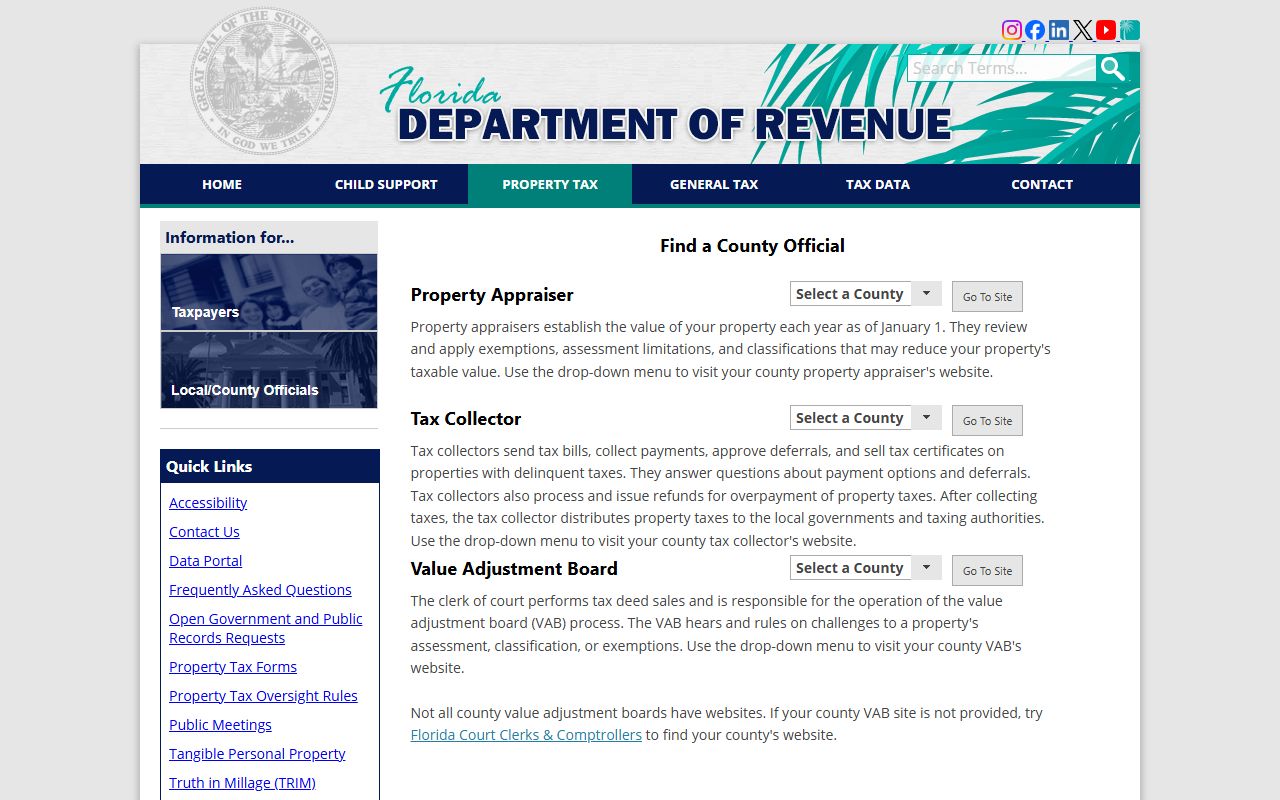
The DOR directory links directly to each county office's website and shows current contact information.
Cities in Miami-Dade County
Miami-Dade County includes several large cities with their own property tax records and services.