
Find Miami Property Tax Records
Miami property tax records are public documents kept by the Miami-Dade County Property Appraiser and the Miami-Dade Tax Collector. These records cover every parcel in the city and include assessed values, exemptions, ownership history, and tax bill data. This guide explains how to search those records, what they contain, and what to do if you need to appeal or apply for an exemption.
Miami Quick Facts
Property Tax in Miami
Miami sits within Miami-Dade County, and all property tax functions are handled at the county level. The city of Miami itself does not have its own property appraiser or tax collector. The Miami-Dade County Property Appraiser values every parcel in Miami as of January 1 each year, using market data, sales comparisons, and property characteristics to arrive at a just value under Chapter 192, Florida Statutes.
Miami has some of the highest property values in the state. Waterfront condos, commercial towers, and single-family homes in desirable neighborhoods can carry assessed values well into the millions. The city is also subject to a wide range of taxing authorities - the county, the school district, the South Florida Water Management District, and several special districts all levy separate millage rates. Your annual tax bill is the sum of all those millage rates applied to your taxable value.
Florida's homestead exemption and the Save Our Homes cap are especially valuable in Miami's high-value market. A homesteaded property's assessed value can only rise by 3% per year or the rate of inflation, whichever is lower. In a market where prices often jump far more than that, the cap creates significant tax savings for long-term homeowners. The catch is that the cap resets when the property sells, so new buyers see a higher assessed value in their first year of ownership.
The Florida Department of Revenue Property Tax Oversight page provides context on how Miami-Dade's assessments fit into the statewide system. The DOR reviews every county's assessment roll annually and certifies it before the tax roll is finalized.
Miami-Dade Property Appraiser
The Miami-Dade County Property Appraiser's main office is at the Stephen P. Clark Center, 111 NW 1st Street, Suite 710, Miami, FL 33128. The phone number is (305) 375-4712. You can email the office at pa@miamidade.gov. The Property Appraiser's website is the primary source for parcel records in Miami.
The online property search lets you look up any parcel by address, owner name, or folio number. A folio number is Miami-Dade's version of a parcel ID. The search returns a full property record showing the legal description, land area, building characteristics, assessed value, taxable value, exemptions, and sales history. The data is updated throughout the year as sales are recorded and permits are issued.
The appraiser's site also has tools for viewing aerial photography and property maps. For condominiums - which make up a large share of Miami's housing stock - the search shows unit-level records as well as the overall building data. This is useful for buyers and investors comparing units in the same building.
Assessment standards follow Florida Department of Revenue guidelines. The appraiser uses mass appraisal methods and is required to achieve a level of assessment at or near 100% of just value. Under Chapter 193, Florida Statutes, just value is the standard for new assessments, with the Save Our Homes cap applied afterward for qualifying homesteaded properties.
The Florida DOR directory lists all county property appraisers and tax collectors, including the Miami-Dade offices.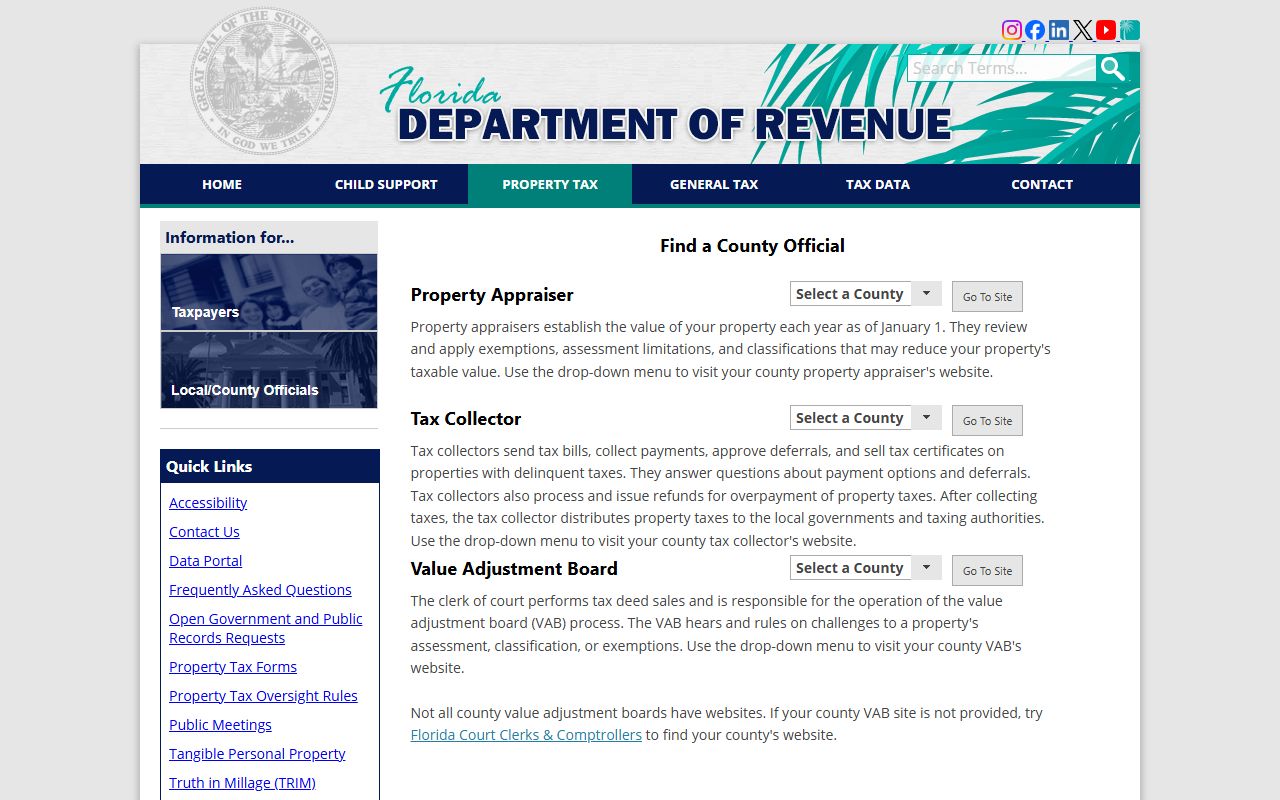
The DOR directory is a quick way to confirm contact details for Miami-Dade county offices.
Tax Collector
The Miami-Dade Tax Collector's main office is at 200 NW 2nd Avenue, Miami, FL 33128. The phone number is (305) 375-5570. Tax bills are mailed in November each year. The Tax Collector's online payment portal lets you pay by credit card or e-check. Early payment earns a discount: 4% in November, 3% in December, 2% in January, 1% in February. After March 31, taxes are delinquent.
Miami-Dade's real estate market means some tax bills are substantial. Commercial and multi-family properties in the city can owe tens of thousands of dollars per year. The installment plan option - which spreads payments across four quarters - can help manage cash flow for owners of high-value properties. Contact the Tax Collector's office to enroll before May 1 each year.
Delinquent taxes trigger a tax certificate sale in June. Investors bid on certificates and pay the overdue taxes. They earn interest at a rate set at the auction. The owner can redeem the certificate at any time before a tax deed application is filed. Under Chapter 197, Florida Statutes, if redemption doesn't happen within two years, the certificate holder can begin the tax deed process. That can lead to the property being sold at public auction.
Miami-Dade also has branch service centers throughout the county. If you live outside downtown Miami, check the Tax Collector's website for a location near you. Many routine transactions - including payments and receipt of tax bills - can be handled at any branch.
How to Search Miami Property Tax Records
Start at the Miami-Dade property search page. You can search by folio number, address, or owner name. The folio number is the most precise way to look up a specific unit in a condo building or a specific lot in a subdivision. If you don't know the folio, search by address and then select the correct parcel from the results.
Once you open a record, you'll see current and prior-year values, exemption detail, building data, and a sales history going back many years. You can also view the property on an aerial map. For payment and billing data, switch to the Tax Collector's payment portal and enter the same folio number.
All Miami property tax records are public under Chapter 119, Florida Statutes. Access is free. No login is needed. You can search as many records as you like without registering. For bulk data, the Florida DOR's statewide data portal has downloadable files at the county level.
If you need certified copies of records, or if you have questions about a specific parcel that the online system doesn't answer, contact the Property Appraiser's office directly. The Stephen P. Clark Center office is open on weekdays during business hours. Staff can pull records and provide written confirmation of assessed values for use in legal or financial matters.
Exemptions Available in Miami
Florida exemptions apply fully to Miami properties. The homestead exemption removes up to $50,000 from the assessed value of a primary residence. The Miami-Dade homestead exemption page explains the application process and what documents you need to bring. The deadline is March 1 each year. Late filings are not accepted for the current tax year.
Homestead also triggers the Save Our Homes cap, which limits annual assessed value increases to 3% or inflation. In a market like Miami, this protection is worth real money. A property bought for $300,000 a decade ago might have a market value of $600,000 today - but its assessed value could still be much lower if it has been continuously homesteaded. All exemptions are governed by Chapter 196, Florida Statutes.
Miami-Dade also has an additional senior exemption for low-income residents over 65. This adds up to $50,000 more off the assessed value for qualifying homeowners. There are also veteran disability exemptions, combat-wounded veteran exemptions, total disability exemptions, and surviving spouse exemptions. Each has its own income or status requirements. All applications are filed with the Property Appraiser's office at 111 NW 1st Street.
Business owners with tangible personal property in Miami must file a TPP return by April 1 to claim the $25,000 exemption on their business equipment. The return goes to the appraiser's office. Businesses with multiple locations file a return for each site and claim the exemption at each one.
VAB Appeals
Miami property owners who disagree with their assessed value can file a petition with the Miami-Dade Value Adjustment Board. The TRIM notice mailed each August starts the 25-day clock to file. The VAB accepts petitions for over-valuation, denial of an exemption, and denial of a classification. Procedures are set by Chapter 194, Florida Statutes.
Cases are heard by special magistrates with appraisal expertise. For commercial properties and high-value residential parcels, many owners hire a property tax agent or attorney to prepare the case. For single-family homes, a self-represented owner with good comparable sales data can make a strong argument. The key is showing that the appraiser's value exceeds what a willing buyer would pay in an arm's-length sale.
Miami's hot real estate market makes appeals harder in years when prices are rising fast. But if your property has condition issues, if the appraiser used the wrong comparables, or if there are data errors in the record, an appeal is worth pursuing. You must pay at least the non-disputed portion of your tax bill while the appeal is pending to avoid delinquency.