
Duval County Property Tax Records
Duval County property tax records cover every parcel inside Florida's consolidated city-county government, one of the largest unified jurisdictions in the country. The Property Appraiser's office sets assessed values, manages exemption filings, and keeps ownership data current, while the Tax Collector handles billing and payment. This page explains how both offices work, how to search records online, and how to file an appeal if you think your assessment is off.
Duval County Quick Facts
Duval County Property Appraiser
The Duval County Property Appraiser is Joyce Morgan. Her office sits at 231 E. Forsyth Street, Suite 260, Jacksonville, FL 32202. You can call them at (904) 255-5900, fax at (904) 255-7963, or email pacustserv@coj.net. Office hours run Monday through Friday, 8 a.m. to 5 p.m. The office operates under the City of Jacksonville's consolidated government structure, which means property records in Duval County are handled through the city's unified system rather than a separate county office.
The appraiser's core job is to set the just value of every parcel in Duval County as of January 1 each year. That means real estate, land, buildings, condos, and tangible personal property used in business. They also handle exemption applications, including homestead exemptions and the Save Our Homes assessment cap. Property ownership transfers, address changes, and new construction updates all flow through this office. Joyce Morgan's team maintains a public-facing property search portal at jacksonville.gov/departments/property-appraiser/property-search where anyone can look up parcels by address, owner name, or parcel ID.
The appraiser also runs a Property Fraud Alert system. This free service emails you when a document is recorded in your property's name. It won't stop fraud but it gives you a fast heads-up so you can act quickly.
The Jacksonville Property Appraiser's website gives you access to the full property search portal, exemption filing tools, and tangible personal property forms. The screenshot below shows the main search interface for Duval County property tax records.
The Jacksonville Property Appraiser's official website is the starting point for most property record lookups in Duval County.
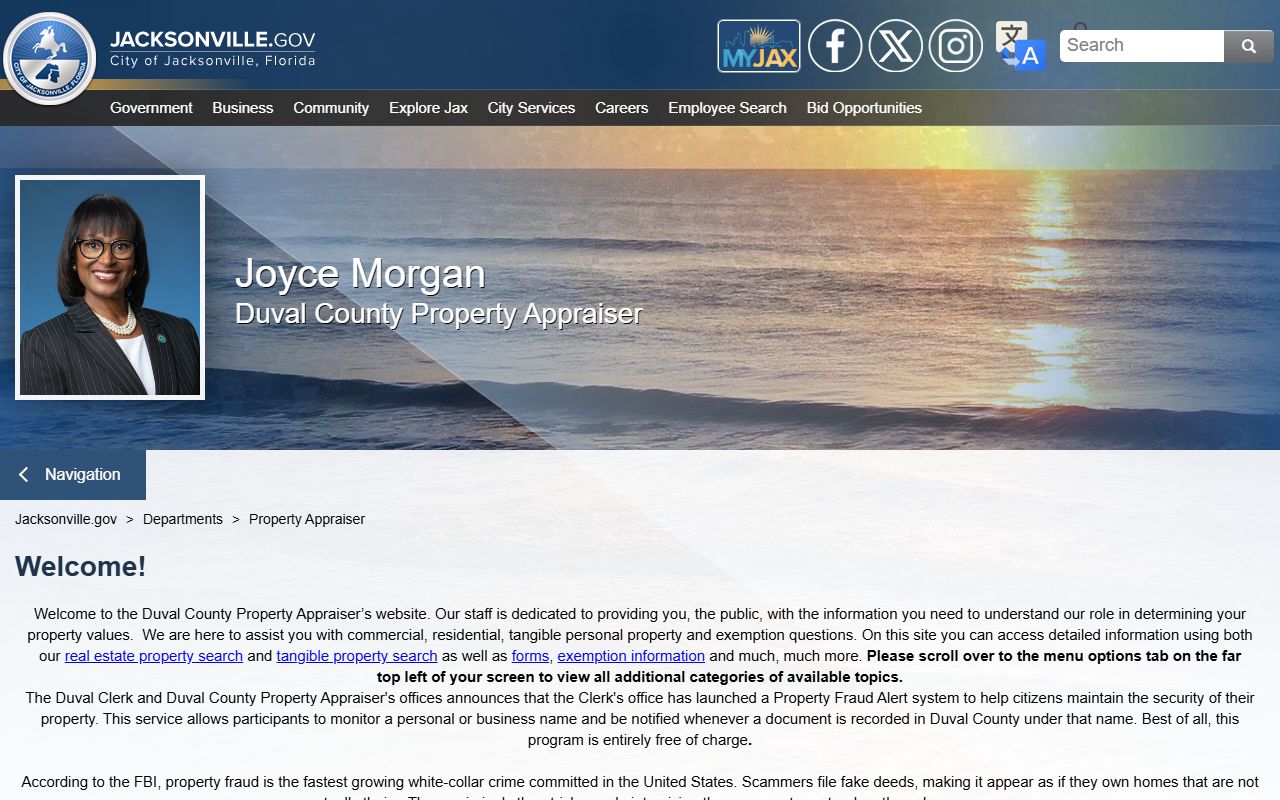
From the Property Appraiser's main page you can reach the property search tool, exemption filing forms, and tangible personal property filing options.
Duval County Tax Collector
The Duval County Tax Collector operates from 231 E. Forsyth Street, Room 130, Jacksonville, FL 32202. Phone is (904) 630-1916 and fax is (904) 630-7312. You can email them at taxcollector@coj.net. The full website is at coj.net/tc. Like the Property Appraiser, the Tax Collector is part of Jacksonville's consolidated city-county structure.
Once the Property Appraiser sets assessed values and exemptions, the Tax Collector takes that data and mails out annual tax bills, called Truth in Millage (TRIM) notices in August, then actual bills in November. They accept payment by mail, online, or in person at branch locations around Duval County. The office also handles delinquent tax certificates, tax deed applications, and business tax receipts. If you want a payoff amount on a delinquent account, contact the Tax Collector directly.
Florida law allows early payment discounts. Pay in November and get 4% off. December brings 3%, January 2%, and February 1%. Taxes become delinquent April 1 of the following year under Florida Statute Chapter 197.
The screenshot below shows the Tax Collector's online portal, which you can use to pay property taxes, search for bills, and check payment history for Duval County parcels.
Visit the Duval County Tax Collector portal to pay tax bills online or check your account status.
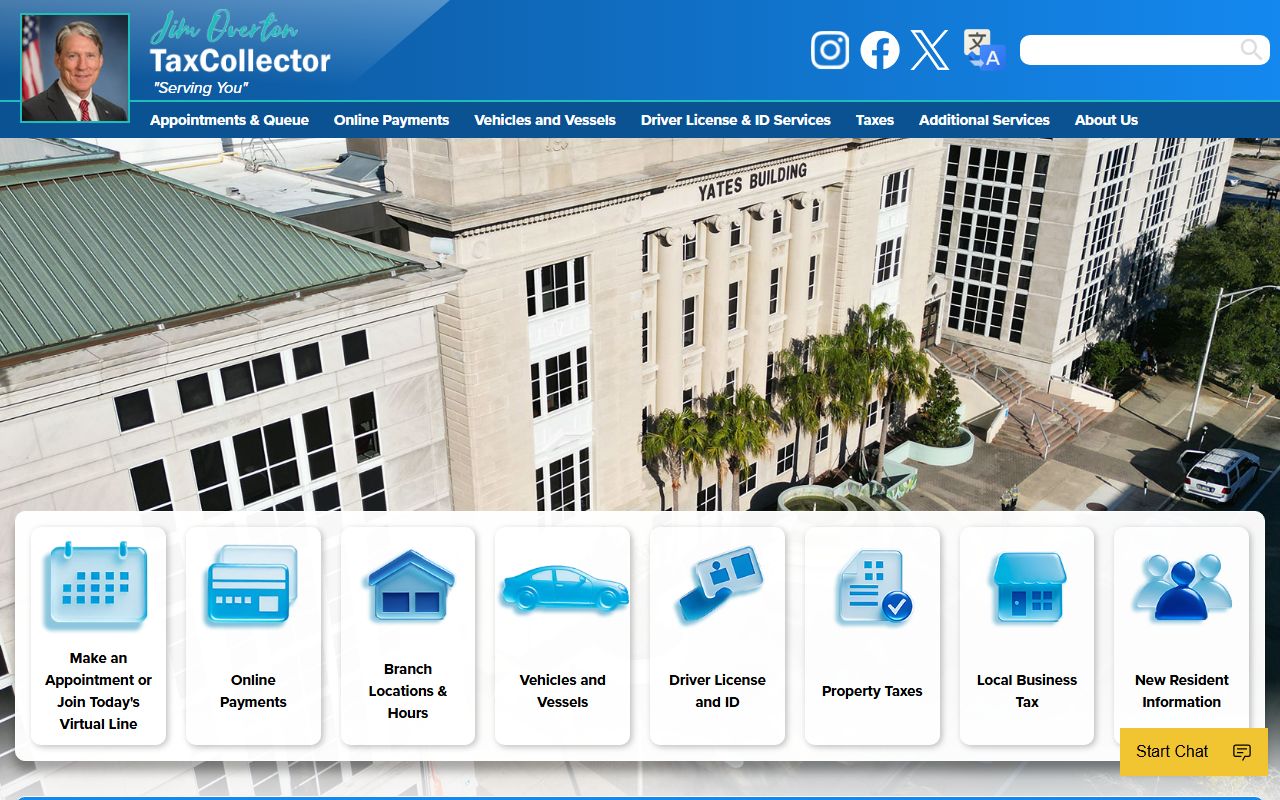
The Tax Collector's site lets you search by address or parcel ID to pull up current and prior year tax bills for any property in Duval County.
Search Duval County Property Tax Records Online
The main property search portal for Duval County is hosted through the Property Appraiser's website. You can search by owner name, property address, or parcel number. Results show the assessed value, taxable value, any exemptions, land use codes, acreage, and recent sale history. The system is public and free to use, no account or login is needed.
For tangible personal property, business owners can file and search TPP accounts through the same portal. The deadline for TPP returns is April 1. If you miss it, the appraiser can assess a penalty. Most Duval County commercial properties have both a real property account and a separate TPP account if the business owns equipment, furniture, or fixtures.
Property tax records in Florida are public records under Chapter 119, Florida Statutes. That means ownership data, assessed values, exemption status, and tax payment history are all open to the public. You do not need to show cause or explain why you want the records. Some personal data, like social security numbers on exemption applications, is exempt from disclosure, but the core property record is always public.
The Florida Department of Revenue data portal also has Duval County parcel data in bulk download format. This is useful if you need large datasets for research or analysis. That portal is at floridarevenue.com/property/Pages/DataPortal.aspx.
Property Tax Exemptions in Duval County
Florida has a strong exemption system, and Duval County residents can take advantage of several options. The most common is the homestead exemption, up to $50,000 off the assessed value of your primary residence. The first $25,000 applies to all tax rolls. The second $25,000 applies only to non-school levies and covers assessed value between $50,000 and $75,000. You must apply by March 1 to get the exemption for that tax year. You can file online through the Property Appraiser's website.
The Save Our Homes (SOH) cap limits how much your homestead property's assessed value can go up each year. The cap is either 3% or the Consumer Price Index, whichever is lower. In years when property values rise sharply, this can keep your tax bill from jumping. The cap travels with you if you move within Florida, that's called portability, and you apply for it when you establish your new homestead. Details on SOH are in Chapter 193, Florida Statutes.
Other exemptions available in Duval County include veterans' exemptions for service-connected disability, widow/widower exemptions, senior exemptions for qualifying low-income homeowners, and exemptions for blind or totally disabled persons. Each has different application requirements. Contact the Property Appraiser's office or check their website for current eligibility rules.
Duval County Property Assessment Appeals
If you think the Property Appraiser set your value too high, you can appeal. The process starts with your TRIM notice. This comes in August and shows your proposed assessed value along with estimated taxes. You have 25 days from the date on the TRIM notice to file a petition with the Value Adjustment Board (VAB). Missing that window closes off the VAB option for that year.
The Duval County VAB handles all property tax appeals filed within the county. You file a petition, pay a small filing fee, and get scheduled for a hearing before a special magistrate. The magistrate reviews the appraiser's evidence and yours, then makes a recommendation. The VAB board votes on it. If you still disagree, you can take the case to circuit court. The appeal rules come from Chapter 194, Florida Statutes.
Before you file a formal petition, it's worth calling the Property Appraiser's office. In many cases, a simple error, like a wrong square footage or a missing exemption, can be fixed without going through the VAB. The office does informal reviews and can correct mistakes on the spot.
Bring comparable sales data if you want to argue your value is too high. The appraiser uses market sales to set values, so recent sales of similar properties in your neighborhood are the strongest evidence you can present at a hearing.
Property Tax Payment in Duval County
Tax bills go out in November. Payment is due by March 31 of the following year. Florida's discount schedule rewards early payment, November is 4%, December 3%, January 2%, and February 1%. After March 31, taxes are delinquent and no discount applies. April 1 brings delinquency status under Chapter 197.
The Tax Collector accepts payment online, by mail, and in person. Online payments can be made by credit card or e-check through the coj.net/tc portal. If you have an escrow account with your mortgage lender, they usually handle payment directly from your escrow funds. It's still worth checking your account every year to confirm the payment posted. Lenders do make errors.
Delinquent taxes become tax certificates at the annual tax certificate sale. Investors bid on the certificates and earn interest while you still own the property. If certificates go unpaid for years, a tax deed application can follow, and you could lose the property. Act quickly if you get delinquency notices.
Accessing and Requesting Duval County Property Tax Records
Most property tax records in Duval County are available online at no cost. The Property Appraiser's search portal gives you assessed values, ownership history, exemption status, land use data, and sales history for any parcel. The Tax Collector's portal shows tax bills, payment status, and delinquency information. Both are free to use.
If you need records that aren't available online, older records, detailed exemption files, or specific documents, you can submit a public records request. Florida's public records law under Chapter 119 applies to both offices. Requests can usually be made by phone, email, or in person. There may be a fee if the request requires extensive staff time to fulfill or involves large volumes of documents.
The Duval County Clerk also offers a Property Fraud Alert service that monitors recordings in your property's name. You can sign up at duvalclerk.gov/services/property-fraud-alert. This is separate from the Property Appraiser but useful for any property owner in Duval County.
The screenshot below shows the Duval Clerk's Property Fraud Alert sign-up page, a free tool for protecting your property from deed fraud.
The Duval Clerk Property Fraud Alert page lets you register your property and receive email alerts when documents are recorded in your name.
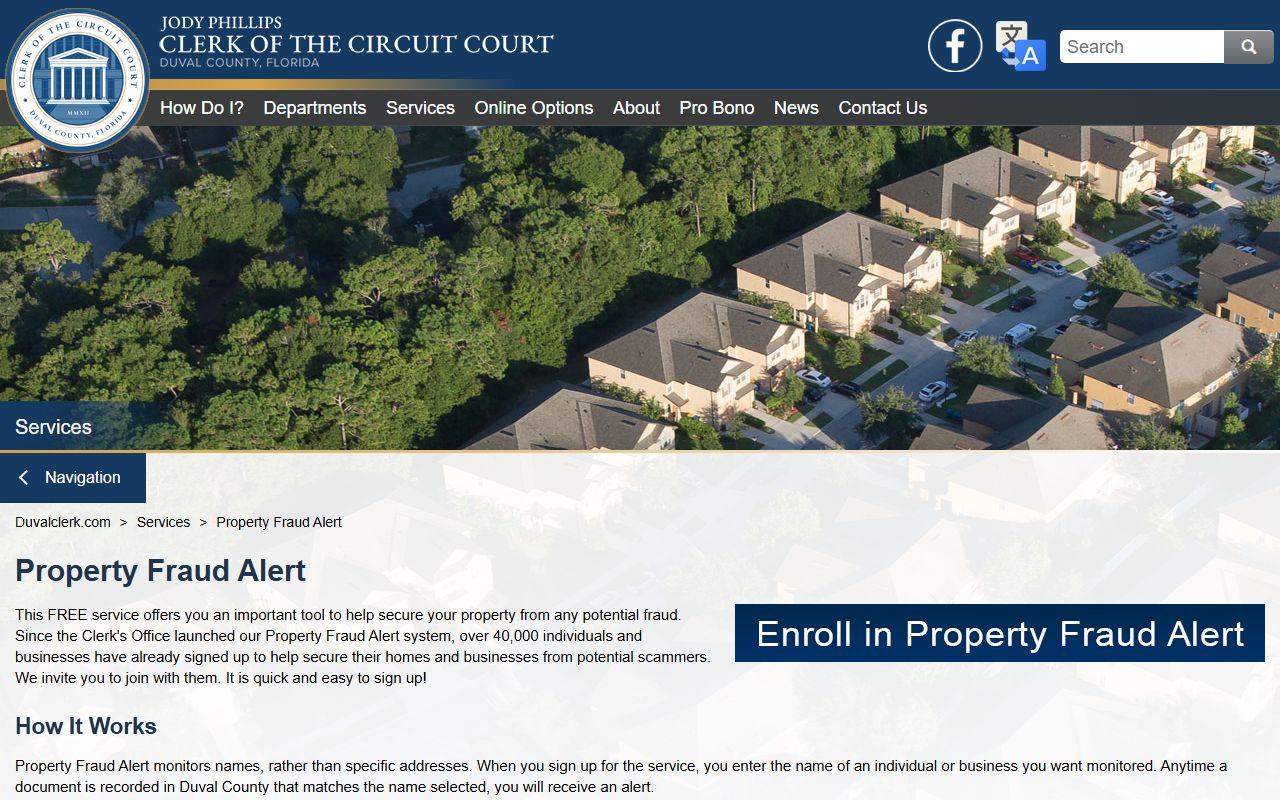
Sign up for the free fraud alert to get notified any time a document is recorded against your Duval County property, a useful layer of protection for homeowners.
For statewide context on how Florida handles property tax oversight, the Florida Department of Revenue's property tax division is at floridarevenue.com/property. They publish forms, guides, and data that apply to every county including Duval.
Cities in Duval County
Jacksonville is the only city in Duval County that meets the population threshold for a dedicated page. Most of Duval County operates under the consolidated Jacksonville city-county government.
Nearby Counties
These counties border Duval County. Each has its own Property Appraiser and Tax Collector handling local property tax records.