
Search St. Johns County Property Tax Records
St. Johns County property tax records are public documents held by the Property Appraiser and Tax Collector offices in St. Augustine, covering every parcel in the county with assessment values, exemption status, ownership data, and billing history.
St. Johns County Quick Facts
St. Johns County Property Appraiser
The St. Johns County Property Appraiser office is located at 4030 Lewis Speedway, St. Augustine, FL 32084. The phone number is (904) 827-5500 and the fax is (904) 827-5510. This office values all real and personal property in St. Johns County as of January 1 each year. That value forms the base for annual tax bills. The appraiser does not collect taxes and does not set millage rates.
St. Johns County has grown fast. It is one of the most rapidly expanding counties in Florida, which means the property roll sees frequent updates. The office tracks every parcel in the county, assigning a legal description, owner name, assessed value, just value, taxable value, and any exemptions. Mass appraisal methods are used, following Florida Department of Revenue guidelines. Values are based on comparable sales and property characteristics, not individual inspections each year.
Parcel records, including assessment history, exemption detail, and sales data, are available through the property appraiser's office. You can contact the office at (904) 827-5500 or visit in person at 4030 Lewis Speedway. The Florida Department of Revenue Property Tax Oversight page explains how assessment standards apply statewide. The legal framework is set out in Chapter 192, Florida Statutes.
For in-depth help with your assessment or to file an exemption, visit the office during regular weekday hours. Staff can walk you through the TRIM notice, explain how the appraiser determined your property's value, and help you understand what exemptions you may qualify for.
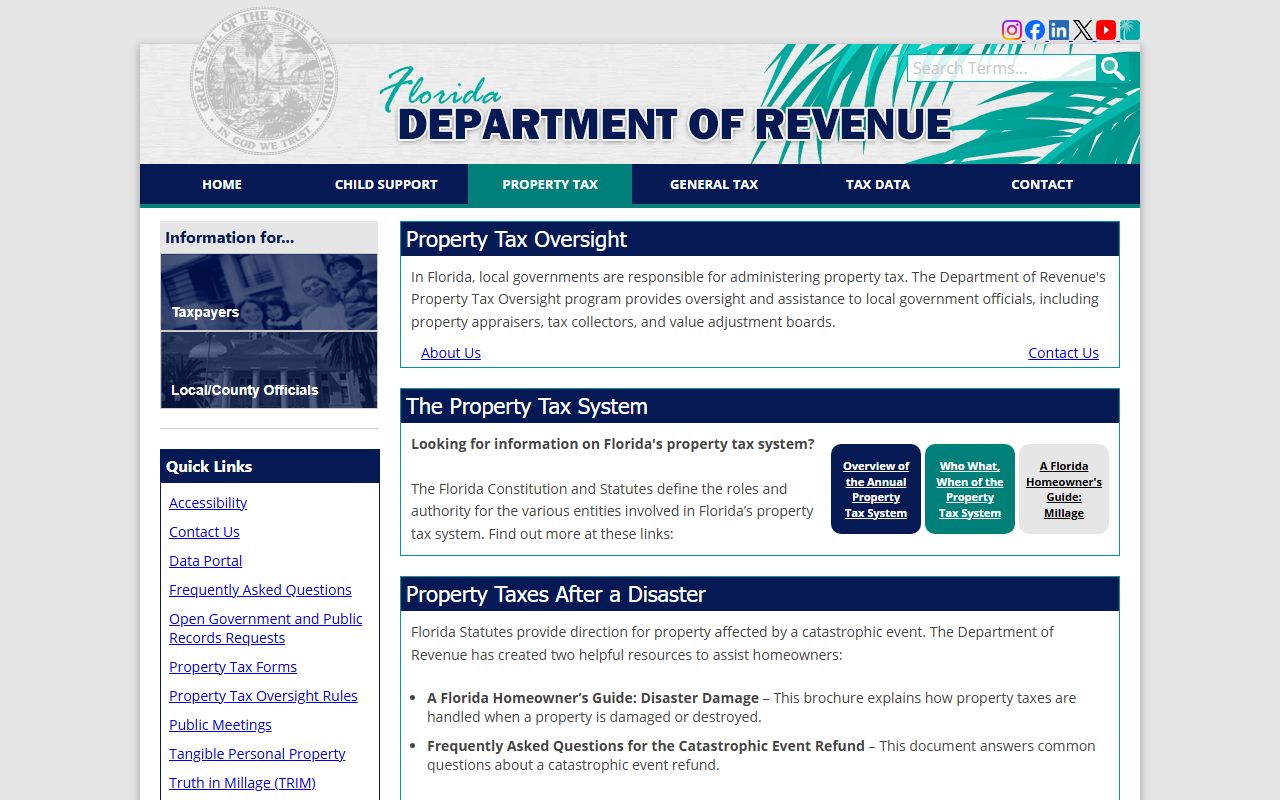
The Florida DOR provides state-level guidance on assessment standards and maintains oversight of all county property appraisers.
Tax Collection in St. Johns County
The St. Johns County Tax Collector manages billing, payment, and enforcement of property taxes. The office mailing address is P.O. Box 9001, St. Augustine, FL 32085-9001. You can reach the Tax Collector at (904) 209-2250. The St. Johns County Tax Collector website is where you go to pay a bill, look up a balance, or find office locations.
Tax bills are mailed in November each year. The amount reflects the taxable value from the appraiser's roll, adjusted for any exemptions, multiplied by millage rates set by the county commission, school board, and applicable special taxing districts. St. Johns County has several such districts, so the total bill on any parcel reflects multiple millage rates combined.
Florida offers an early payment discount. Pay in November for 4% off. December earns 3%, January 2%, and February 1%. After March 31, taxes become delinquent. The Tax Collector then conducts a certificate sale under Chapter 197, Florida Statutes. Investors pay the delinquent taxes and receive interest-bearing certificates. Property owners can redeem those certificates, but failure to do so within two years can lead to a tax deed action.
The St. Johns County Tax Collector website handles online payments and account lookups for all county tax bills.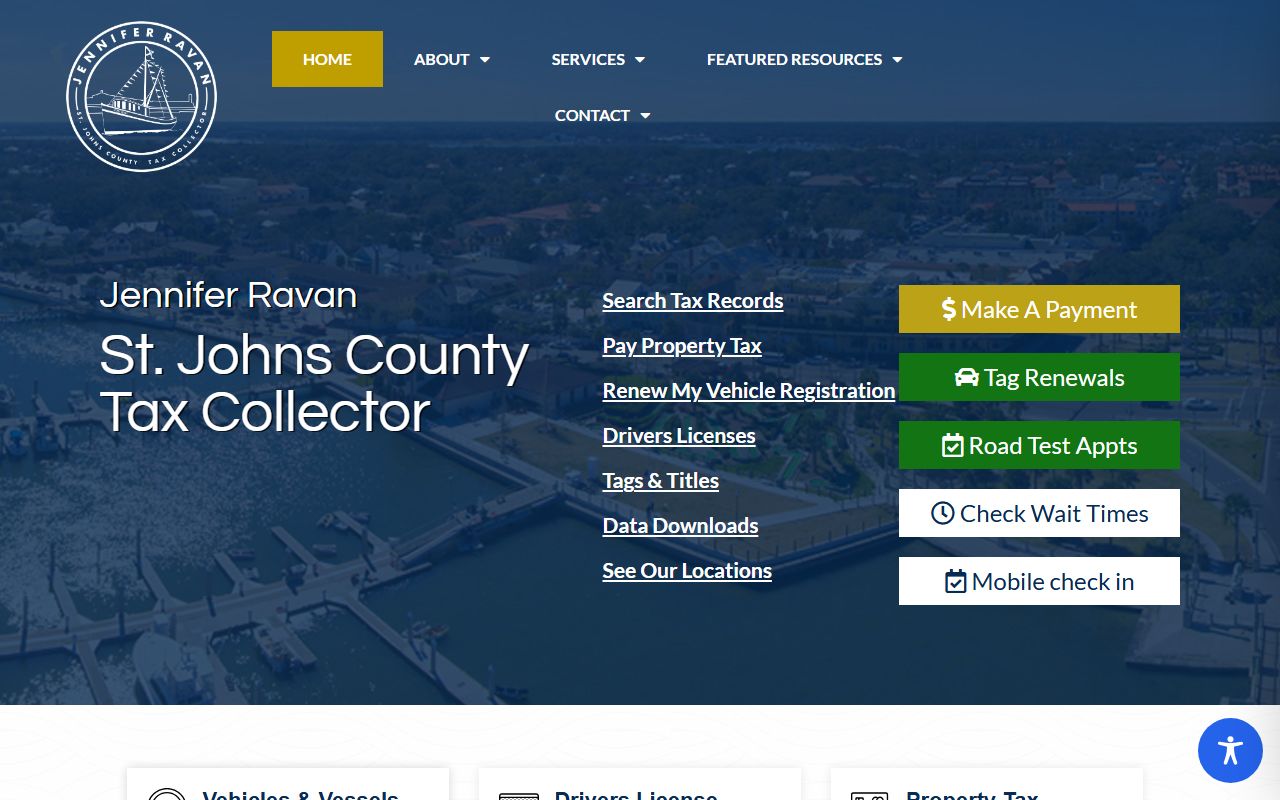
Online payment through the tax collector's site is available and accepts major credit cards and e-checks.
How to Find St. Johns County Property Tax Records
The property appraiser's office is your first stop for assessment data. Search by owner name, property address, or parcel ID to find any parcel in the county. Records show current and prior-year values, building and land data, exemption status, and sales history. Access is free and no login is required.
For tax billing and payment data, visit the St. Johns County Tax Collector website. You can look up a current balance due, view payment history, or find out if a tax certificate has been issued on a property. These two databases give a complete picture when used together.
The Florida Department of Revenue also offers a statewide property tax data portal with bulk data downloads. This is useful for title researchers, investors, and analysts who need more than individual parcel lookups.
All records are public under Chapter 119, Florida Statutes. No reason is needed to access them. You do not have to be a Florida resident. Certain personal information, Social Security numbers on exemption applications, for example, is confidential, but the core assessment and tax data is fully open to anyone.
Property Tax Exemptions in St. Johns County
Florida's exemption programs apply to qualifying St. Johns County parcels. The homestead exemption is the most widely used. It reduces assessed value by up to $50,000 on a primary residence. The first $25,000 covers all taxing authorities. The second $25,000 applies to assessed value between $50,000 and $75,000 and does not apply to school taxes.
Once homestead is in place, the Save Our Homes cap limits annual assessment increases to 3% or the rate of inflation, whichever is less. This protection is established under Chapter 193, Florida Statutes. In a fast-growing market like St. Johns County, the SOH cap can make a significant difference in how much tax a long-term homeowner pays compared to a recent buyer at the same value.
Additional exemptions are available for seniors with low income, veterans, disabled persons, and widows and widowers. Each has its own criteria. Most must be applied for by March 1. You file with the Property Appraiser's office at 4030 Lewis Speedway. The governing statute for all Florida exemptions is Chapter 196, Florida Statutes.
Businesses operating in St. Johns County can claim a $25,000 exemption on tangible personal property by filing a TPP return with the appraiser by April 1 each year.
Appealing Your St. Johns County Property Assessment
Every summer, the Property Appraiser sends TRIM notices. These show the proposed assessed value and estimated taxes. If you think your value is too high, you have 25 days from the TRIM mailing date to file a petition with the St. Johns County Value Adjustment Board.
The VAB holds hearings before special magistrates. You present evidence that the assessed value is wrong. Good evidence includes recent sales of similar properties, photos of damage or condition problems, and an independent appraisal. The magistrate reviews both sides and makes a recommendation. The board then votes. All of this follows Chapter 194, Florida Statutes.
If the VAB rules against you, circuit court is still an option. Most cases settle before that point. The filing fee for a VAB petition is modest. You do not need a lawyer, though commercial property owners often use one. Pay at least the non-disputed portion of your tax bill during the appeal to avoid penalties.
Payment Options in St. Johns County
Bills go out in November. Pay in that month and you save 4%. Discounts step down by 1% each month through February. The full amount is due by March 31 or the account goes delinquent.
The Tax Collector's website accepts online payments by card or e-check. Mail a check to P.O. Box 9001, St. Augustine, FL 32085-9001. In-person payment is available at the collector's office locations. The office phone is (904) 209-2250 if you need current hours or branch information.
St. Johns County offers a quarterly installment plan. Enroll in the spring before the tax year starts. Payments spread out over four installments in June, September, December, and March. It's a practical option if a large lump-sum November payment causes cash flow problems.
Delinquent taxes trigger a certificate sale each June. Certificates earn interest. If unredeemed after two years, the certificate holder can apply for a tax deed. That can mean losing the property. The Florida Tax Collectors Association has resources on this process statewide.
Public Records in St. Johns County
Florida's public records law, Chapter 119, Florida Statutes, makes nearly all government records open to anyone. Property tax records are no exception. Assessment rolls, tax rolls, payment histories, and exemption records are all public. You do not need to show ID or give a reason.
Online access is free through the Property Appraiser and Tax Collector websites. For records not yet online, or for certified copies, submit a written request directly to the relevant office. Large requests may come with a fee for staff time or copies, but the information itself is not restricted.
The Florida DOR directory of county property appraisers and tax collectors lists contact information for all county offices, including St. Johns County, if you need to reach the offices directly for records requests or other matters.
Cities in St. Johns County
St. Augustine is the county seat and the oldest continuously occupied European settlement in the United States. Other communities in St. Johns County include Ponte Vedra Beach, Nocatee, St. Augustine Beach, Fruit Cove, and Palm Valley. All parcels in these areas are assessed by the St. Johns County Property Appraiser. No cities in St. Johns County currently meet the population threshold for individual city pages.