
Find Property Tax Records in Clay County
Clay County property tax records are public documents maintained by two offices in Green Cove Springs: the Property Appraiser, who determines assessed values for every parcel in the county, and the Tax Collector, who bills and collects taxes each year. This page covers how to search Clay County tax records, find parcel data for properties in Fleming Island, Orange Park, Middleburg, and elsewhere in the county, and how to use available tools to review assessments, exemptions, and payment history.
Clay County Quick Facts
Clay County Property Appraiser
The Clay County Property Appraiser's Office mailing address is P.O. Box 218, Green Cove Springs, FL 32043. Phone: (904) 284-6320. Fax: (904) 278-4724. The office website is at ccpao.com. The property appraiser is elected and operates independently from the county commission. Every year, the appraiser values all real property, land and buildings, and tangible personal property used in business, using sales data, income analysis, and cost methods.
Assessment is always as of January 1. If you buy a home in June, the assessed value for that tax year was set in January. If you add a room in September, the improvement is not factored in until the following January. The appraiser's office must certify the tax roll by October 1, after which the Tax Collector begins billing. In August, every property owner receives a TRIM notice listing their proposed assessed value, exemptions, and the rates proposed by each taxing authority, school board, county commission, water management, and others.
Clay County has seen significant growth in recent years, with communities like Fleming Island and Oakleaf drawing large numbers of new residents from the Jacksonville metro area. That growth creates pressure on assessed values. The appraiser's office uses sale prices of recently transferred properties to keep assessed values in line with the market. If sales in your neighborhood have climbed, your assessed value likely will too.
The Clay County Property Appraiser's website at ccpao.com is the main tool for parcel searches and assessment data in the county.
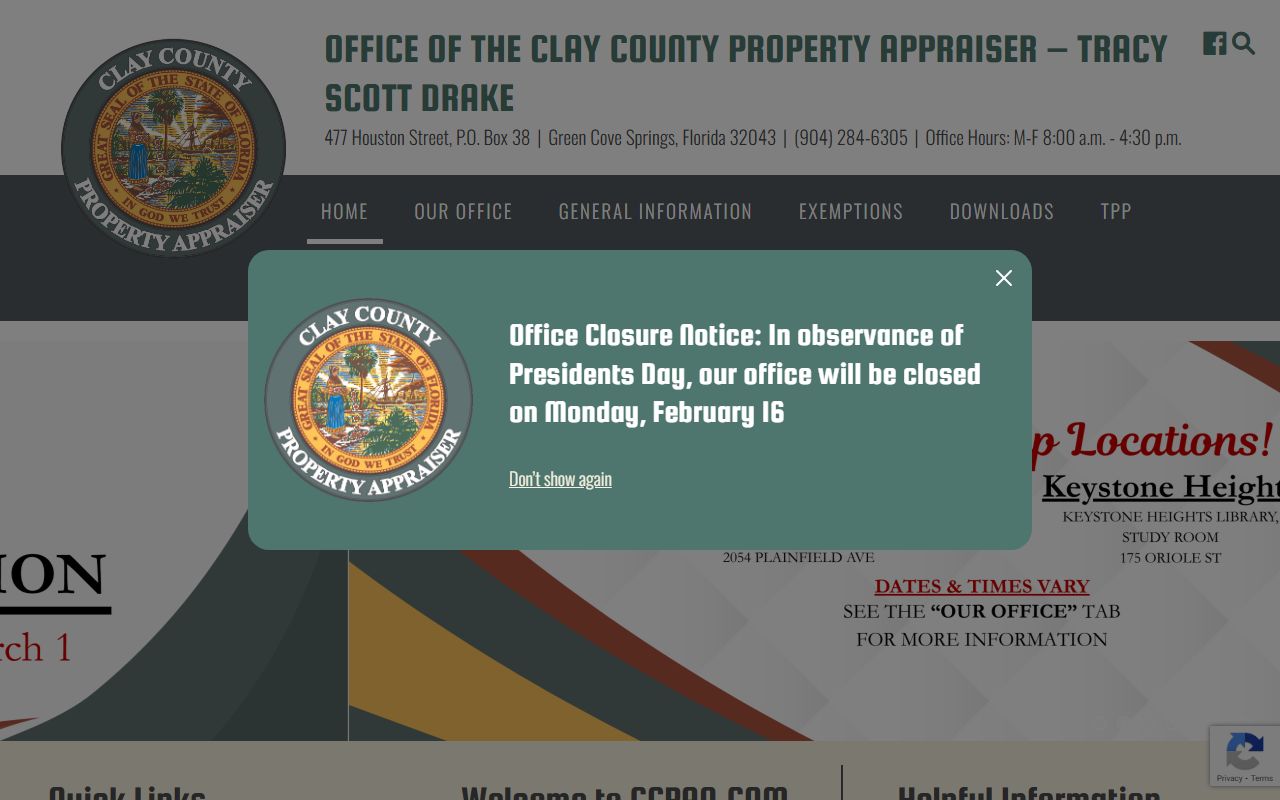
The site offers owner name searches, address lookups, parcel map tools, and downloadable data for Clay County properties.
Clay County Tax Collector
The Tax Collector's mailing address is P.O. Box 218, Green Cove Springs, FL 32043, with phone (904) 284-6320 and fax (904) 278-4724. The collector is a separate elected official from the appraiser. Once the tax roll is certified in October, the collector's job is to generate and mail tax bills, accept payments, and manage delinquent accounts. Bills go out by November 1 each year.
The collector also processes installment plans, issues tax certificates for delinquent parcels, and works through the tax deed process when certificates go unredeemed. Outside of property taxes, the Tax Collector's office handles vehicle registration, driver license services, and hunting and fishing licenses. If you need to know your current tax bill or confirm a past payment, the Tax Collector is the right starting point.
Clay County has multiple branch office locations beyond the Green Cove Springs headquarters, serving areas like Orange Park and Keystone Heights. The main website lists office hours and locations. Online payment is available and generally does not require you to appear in person for standard transactions.
Note: The Tax Collector does not set or change assessed values. That authority rests entirely with the Property Appraiser. If your bill seems too high because of the assessed value, contact the appraiser's office.
How to Search Clay County Property Tax Records
The appraiser's website at ccpao.com is the place to start for parcel data. Search by owner name, property address, or parcel ID number. The parcel ID, sometimes called a property identification number or PIN, is the most reliable search method. If you have it from a deed, a prior tax bill, or a title report, use it to pull the exact record without worrying about address format variations.
Each parcel record shows the owner of record, the mailing address, the property use code, land and improvement values, the total assessed value, any exemptions, and the legal description. Sales history shows when the property last sold and for how much. That data feeds into the appraiser's comparable-sale analysis and explains how values get set in your area. Building sketches and aerial photos are usually available as well.
For payment records and current bills, search the Tax Collector's system. You can look up by parcel number or address. The collector's records show the current amount due, prior-year payments, any installment plan status, and whether a tax certificate has been issued. All of this is public under Chapter 119, Florida Statutes.
For bulk data, the Florida Department of Revenue's data portal at floridarevenue.com/property/Pages/DataPortal.aspx provides downloadable assessment roll files for all Florida counties including Clay.
Property Tax Exemptions in Clay County
The homestead exemption is the most valuable break for Clay County homeowners. It reduces assessed value by up to $50,000. The first $25,000 of that reduction applies to every taxing authority, including the school board. The second $25,000 only applies to non-school taxing bodies, and only if your assessed value is between $50,000 and $75,000. File with the Property Appraiser by March 1 and you must be a Florida resident using the property as your primary home on that date.
The Save Our Homes cap protects homestead-exempt properties from large year-over-year value increases. Once you have homestead status, your assessed value can only go up by 3% or the prior year's Consumer Price Index change, whichever is lower. In high-growth markets like Clay County, where home prices have risen significantly, the SOH cap can save homeowners thousands of dollars per year in taxes. Chapter 193, Florida Statutes sets out how the cap works and how portability lets you transfer your SOH benefit when you move to a new Florida home.
Other exemptions available in Clay County include the veteran disability exemption, the total and permanent disability exemption, the widow and widower exemption, and exemptions for deployed military members. Senior citizens with low incomes may qualify for an additional exemption beyond the standard homestead amount. The appraiser's office reviews applications and determines eligibility.
Businesses must file a tangible personal property return by April 1. The first $25,000 in assessed TPP value is exempt, but you lose that exemption if you fail to file. See Chapter 196, Florida Statutes for complete rules on all Florida property tax exemptions.
Appealing Your Clay County Property Assessment
Got a TRIM notice that looks too high? Start by calling the Clay County Property Appraiser. Bring or send comparable sales data, a private appraisal if you have one, or photos showing condition issues. The appraiser's staff can review the property record for errors, wrong square footage, wrong bedroom count, wrong property class, and correct them. Many assessments get adjusted at this informal stage.
If the informal review does not resolve the dispute, file a petition with the Clay County Value Adjustment Board. The deadline is 25 days from the mailing date of the TRIM notice. That date appears on the notice itself. Don't assume you have extra time. The VAB hearing assigns a special magistrate to review your evidence and the appraiser's evidence and make a recommendation to the full board.
You need to prove the appraiser's value is not justified by the market evidence. Comparable sales from around January 1 of the tax year carry the most weight. Recent sales from late in the prior year also factor in. Chapter 194, Florida Statutes details the VAB process and the rights of property owners who file petitions. If the board rules against you, circuit court is the next option, but that involves attorney fees and more formal procedure.
Pay your taxes on time regardless of any pending appeal. A VAB petition does not stop the clock on delinquency. Pay, win your case, and collect the refund.
Paying Clay County Property Taxes
Tax bills come out November 1. The deadline for payment without penalty is March 31. Florida's discount schedule makes early payment worthwhile. November brings 4% off. Each month after that loses one point, 3% in December, 2% in January, 1% in February. Full payment after March 31 means no discount and delinquent status starting April 1.
The Clay County Tax Collector accepts online payments, mail-in checks, and in-person payments at multiple locations. Check the collector's website for branch hours and accepted payment methods. Online payments may carry a convenience fee for credit card transactions. ACH transfers are usually fee-free. The Florida Tax Collectors Association at floridataxcollectors.com provides guidance on statewide payment practices.
The quarterly installment plan lets you break the annual bill into four payments. Apply by April 30 to enroll for the following tax year. Each installment has its own due date and discount. Missing an installment can remove you from the plan. For large properties or investment accounts with multiple parcels, the installment plan helps with cash flow.
Delinquent taxes trigger a certificate sale. Investors pay the overdue amount and earn interest at a rate bid at auction. The property owner must pay the investor back to redeem the certificate. After two years, the investor can apply for a tax deed and start the process toward a forced sale. Chapter 197, Florida Statutes governs the full collection and delinquency process.
Clay County Property Records and Public Access
All Clay County property tax records are public documents under Chapter 119, Florida Statutes. That means assessed values, owner information, parcel data, exemption types, and payment history are all accessible to anyone who asks. You do not need to explain why you want the records or have a personal stake in the property.
What is not public: Social Security numbers, personal income data, financial records submitted to qualify for exemptions, and bank or payment account numbers used for electronic payments. The fact that an exemption exists and its type is public, but the supporting financial documents are not. These protections apply statewide.
Most Clay County property tax records are available online at no cost through the appraiser's and collector's websites. If you need certified copies, paper printouts, or bulk data sets, contact the offices directly. Small reproduction costs may apply. The Florida Department of Revenue also offers property tax forms, data downloads, and guidance at floridarevenue.com/property/Pages/Forms.aspx.
The Florida Department of Revenue's Property Tax Oversight program monitors and supports all county property appraisers, including the Clay County office.
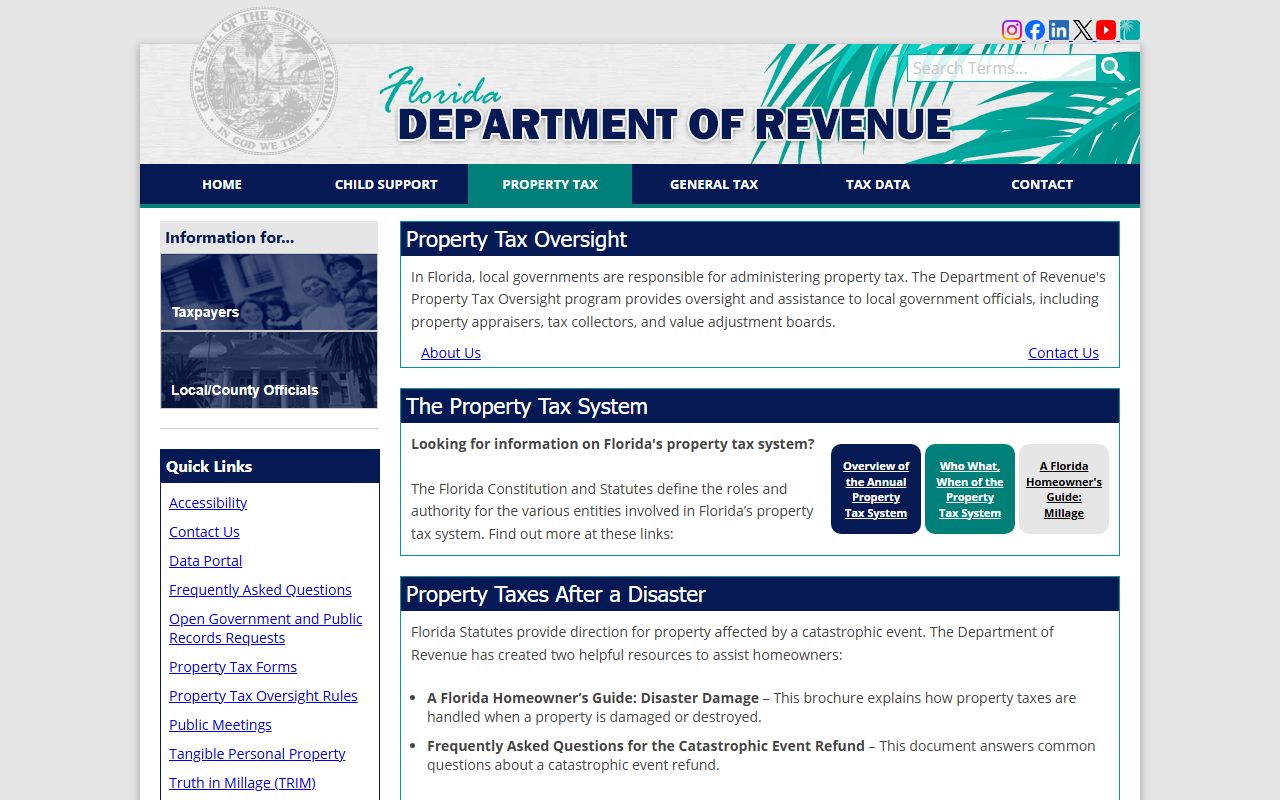
The DOR website provides links to county contacts, statewide data, exemption rules, and answers to common questions about Florida's property tax system.
Cities in Clay County
Clay County communities include Orange Park, Fleming Island, Middleburg, Green Cove Springs, Keystone Heights, and Oakleaf Plantation. Green Cove Springs is the county seat and the location of both the Property Appraiser and Tax Collector offices. None of Clay County's communities currently exceed the 75,000-population threshold, so no individual city pages exist at this time. All property records for these communities are handled through the county-level offices described above.