
Charlotte County Property Tax Records
Charlotte County property tax records are maintained by two separate offices: the Property Appraiser, who sets assessed values, and the Tax Collector, who sends bills and takes payments. This page covers how to search parcel records, look up assessment data, understand exemptions, and get copies of tax documents for any property in Charlotte County. Whether you own land in Punta Gorda, Port Charlotte, or a rural stretch of the county, this guide helps you find what you need fast.
Charlotte County Quick Facts
Charlotte County Property Appraiser
The Charlotte County Property Appraiser operates out of 18500 Murdock Circle in Port Charlotte, FL 33948. You can reach the office by phone at (941) 743-1350 or by fax at (941) 637-2276. The appraiser is an elected official, independent from the county commission, who is responsible for placing a fair market value on every parcel in Charlotte County as of January 1 each year. That date is fixed by state law, and it does not change regardless of when a sale or improvement happens.
The office handles real property, land, buildings, mobile homes, as well as tangible personal property used in business. They also process exemption applications, keep the county's tax roll, and send out the TRIM (Truth in Millage) notice each August. That notice tells property owners their proposed assessed value and the tax rates set by each taxing authority. It is not a bill. It is a chance to review the numbers before they become final.
The appraiser's online portal lets you look up any parcel by address, owner name, or parcel ID number. You can view assessment history, recent sales data, property sketches, and aerial maps. Most of this data goes back several years, which is useful if you are tracking how values have changed over time.
The Florida Department of Revenue provides statewide oversight through its Property Tax Oversight program. You can learn more about how counties fit into that system at floridarevenue.com/property/Pages/LocalOfficials.aspx.
The Florida Department of Revenue's Property Tax Oversight page lists contact information for every county appraiser and tax collector in the state.
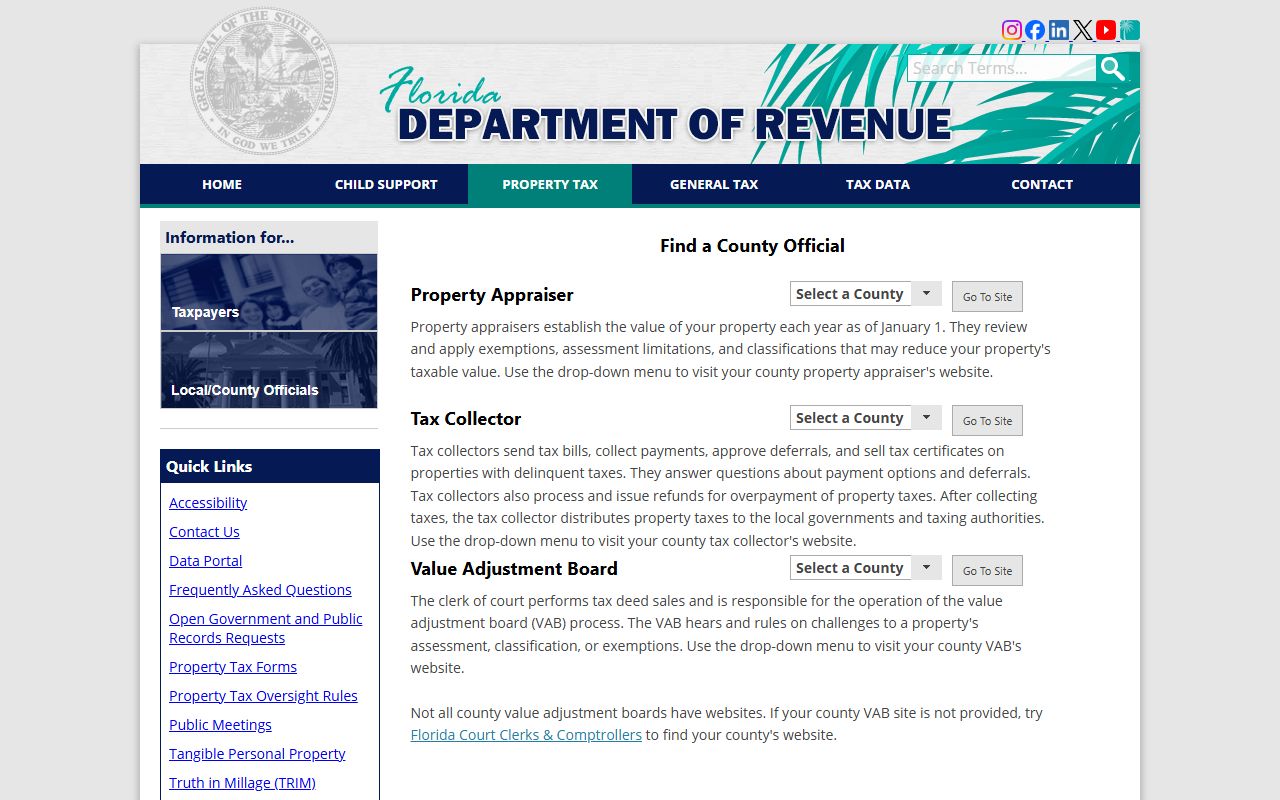
This resource is a good starting point if you need to compare offices or find contact details across multiple counties.
Charlotte County Tax Collector
The Tax Collector's office is also located at 18500 Murdock Circle, Port Charlotte, FL 33948, with the same main phone number: (941) 743-1350. The collector is a separate elected official from the appraiser. Once the appraiser certifies the tax roll in October, the collector takes over. Bills go out by November 1. You can pay online through taxcollector.charlottecountyfl.gov, by mail, or in person at the office.
Florida law gives property owners a discount for paying early. Pay in November and you get 4% off. December brings a 3% discount, January a 2% discount, and February cuts 1%. After March 31, the bill is delinquent. On April 1, a tax certificate sale process begins for unpaid accounts. That matters if you are buying a property that has had past-due taxes.
The collector also handles vehicle registrations, hunting and fishing licenses, and business tax receipts. For property tax purposes, the key functions are accepting payments, issuing tax certificates, and maintaining payment history records.
Note: The Tax Collector can tell you what is owed and whether a bill is current, but questions about the assessed value go back to the Property Appraiser's office.
How to Search Charlotte County Property Tax Records
Start with the Property Appraiser's online database. You do not need an account. Go to the appraiser's website and use the parcel search tool. Enter the street address, owner name, or parcel identification number (PIN). The PIN is a unique number assigned to every piece of land in the county. If you have it, that is the fastest way to find a specific record.
Each parcel record shows the current assessed value, the land value, the building value, any exemptions applied, and the legal description of the property. You can also see recent sales, which the appraiser uses to set values for similar properties nearby. Some records include a sketch of the building's footprint and a breakdown of square footage by use type.
For tax payment history and outstanding balances, you shift over to the Tax Collector's website. You can search by parcel number or address. The collector's site shows the current year's bill, any installment plan details, and prior-year payment records. If a property had a tax certificate issued, that information may appear as well.
All Charlotte County property tax records are public under Chapter 119, Florida Statutes. You can request copies in person or by mail. Some records, tax returns, income data, and Social Security numbers, are confidential, but assessed values, ownership data, and payment records are open to anyone.
The Florida Department of Revenue's data portal provides bulk property data that can supplement individual parcel searches.
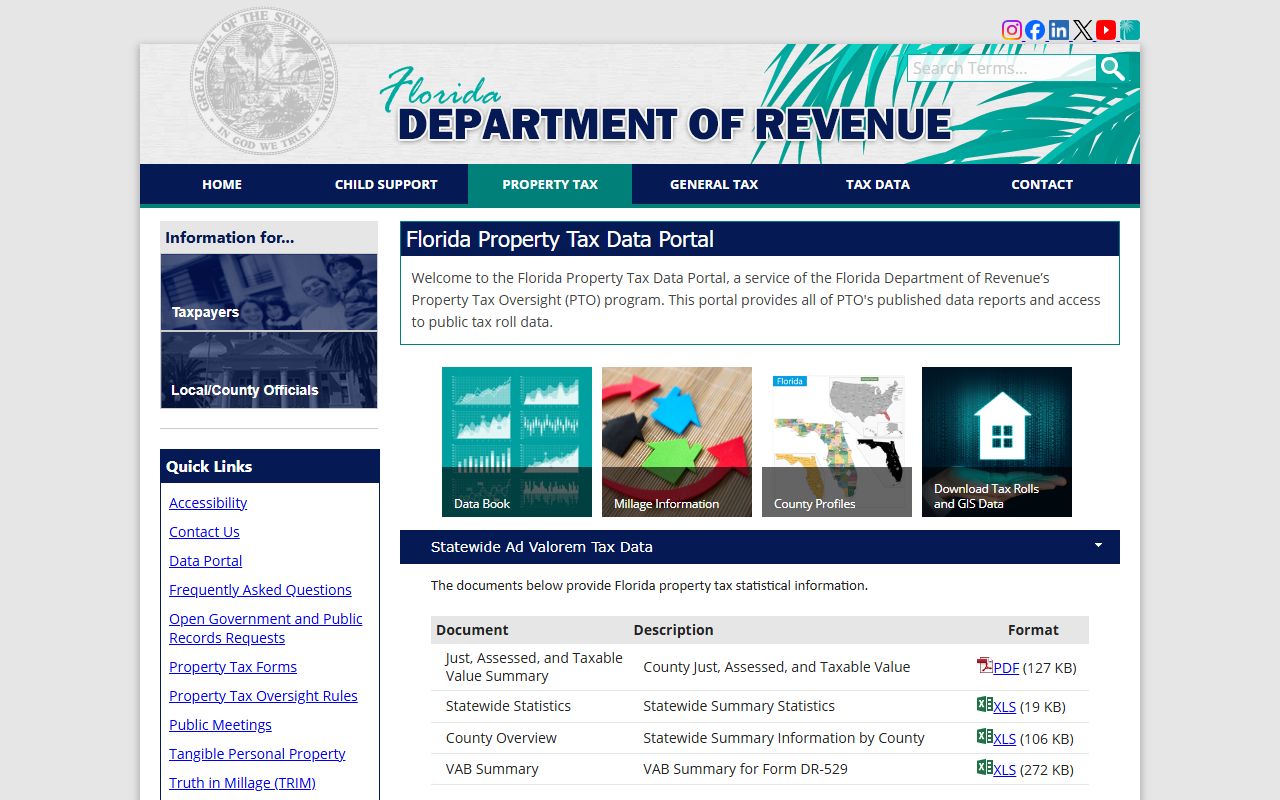
The data portal is especially useful for researchers, appraisers, and anyone who needs countywide or statewide assessment data.
Property Tax Exemptions in Charlotte County
Florida law provides several exemptions that can reduce the taxable value of your property. The most common is the homestead exemption, worth up to $50,000 on a primary residence. The first $25,000 applies to all taxing authorities. The second $25,000 applies only to non-school taxes and kicks in on assessed values between $50,000 and $75,000. To claim it, you must be a Florida resident, own and occupy the property as your primary home, and file by March 1 of the tax year.
Once you have homestead status, the Save Our Homes (SOH) assessment cap limits how much your assessed value can rise each year. The cap is either 3% or the change in the Consumer Price Index, whichever is lower. That protection can build up over time, creating a gap between your assessed value and what the market says the property is worth. Chapter 193, Florida Statutes governs how the SOH cap is applied and calculated.
Other exemptions available through the Charlotte County Property Appraiser include the widow/widower exemption, total and permanent disability exemptions, veterans' exemptions including the combat-related disability exemption, and the senior citizen low-income exemption. Each has its own eligibility rules and documentation requirements.
Businesses and rental properties also have deadlines. The tangible personal property (TPP) return is due April 1 each year. Missing that deadline results in a penalty. The $25,000 TPP exemption applies automatically only if you have filed a return in a prior year with no assessed value above the threshold. See Chapter 196, Florida Statutes for the full list of exemptions and eligibility rules.
Appealing Your Charlotte County Assessment
If you think your property's assessed value is too high, you have options. The first step is to contact the Charlotte County Property Appraiser's office directly. Many issues get resolved at this level without any formal process. Bring any evidence you have: recent sales of comparable homes, a private appraisal, photos showing condition issues, or errors in the property record.
If you cannot reach an agreement with the appraiser's office, the next step is to file a petition with the Value Adjustment Board (VAB). The deadline is 25 days after the mailing date of the TRIM notice, which goes out in August. Do not miss this deadline. Late petitions are not accepted. The VAB is a separate body that hears property tax disputes, and it includes county commissioners, school board members, and citizen members.
At the VAB hearing, a special magistrate reviews the evidence and makes a recommendation. You need to show that the appraiser's value is not supported by the evidence. The burden of proof shifts based on the type of challenge. Chapter 194, Florida Statutes covers the full VAB process, petition requirements, and taxpayer rights.
If you are still unhappy after the VAB decision, you can file a lawsuit in circuit court. That is a more involved process and typically requires an attorney. Most taxpayers resolve their disputes either informally with the appraiser or through the VAB.
Note: Filing a VAB petition does not delay your tax payment obligation. You still need to pay the disputed taxes by the March 31 deadline to avoid delinquency, though you may be eligible for a refund if you win.
Paying Charlotte County Property Taxes
Tax bills for Charlotte County go out by November 1. The full amount is due by March 31. Most property owners pay in full early to capture one of the discount tiers. If you pay in November, you save 4%. Each month the discount drops by one percentage point. By February it's 1%, and after March 31 the bill is delinquent with no discount.
The Tax Collector accepts payments online at taxcollector.charlottecountyfl.gov. You can also pay by mail or in person at the office on Murdock Circle. For large or commercial properties, some owners use an installment plan. The quarterly installment plan requires an application by April 30 and splits the annual bill into four payments. There are specific discount rates for each installment. The Florida Tax Collectors Association provides guidance on statewide practices at floridataxcollectors.com.
Delinquent taxes lead to a tax certificate sale, which happens in late May or early June. Investors bid on the certificates, paying the overdue amount plus interest. The property owner then owes the investor the redemption amount to clear the lien. After two years, the certificate holder can apply for a tax deed, which can lead to a forced sale of the property. This is governed by Chapter 197, Florida Statutes.
If you own property with a mortgage, your lender typically pays the tax bill from an escrow account. But it is still your responsibility to make sure taxes get paid. Check your escrow statement each year and confirm payment was made.
Charlotte County Property Records and Public Access
Florida's public records law is broad. Under Chapter 119, Florida Statutes, government records, including property tax records, are presumed open unless a specific exemption applies. Charlotte County follows this law. Most property records are available online for free, but you can also request them in writing.
What you can access: assessed values, property addresses, owner names and mailing addresses, sales history, legal descriptions, exemption types (not dollar amounts in all cases), and tax payment records. What is kept confidential: Social Security numbers, federal tax return data, income and expense records submitted with exemption applications, and bank account information used for electronic payments.
If you need certified copies of records or a large set of data, contact the Property Appraiser's office directly. Some bulk requests involve a nominal production cost. The Florida Department of Revenue's data portal also offers downloadable assessment rolls for researchers and data users.
The Florida Department of Revenue maintains a frequently asked question resource covering property tax access, exemptions, and procedures statewide.
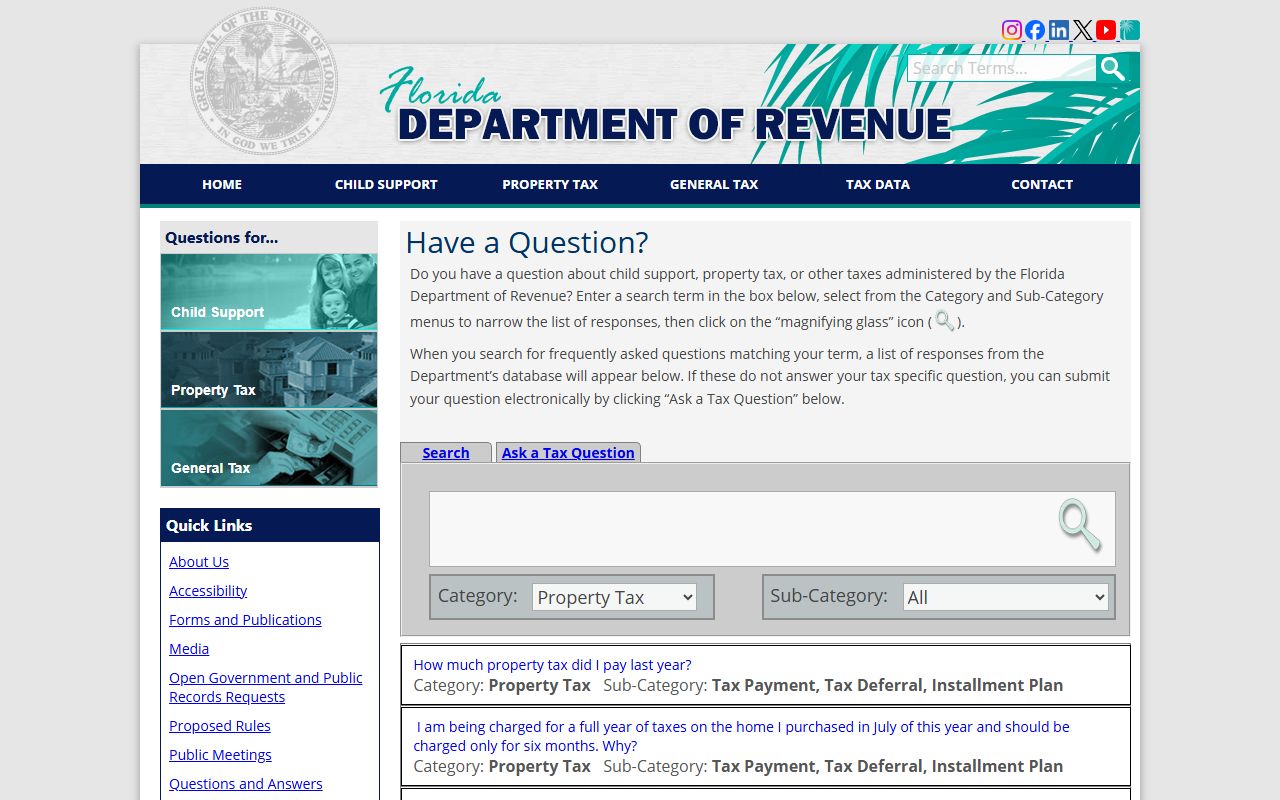
Reviewing that FAQ can save you a call to the office on common questions about deadlines, exemption eligibility, and public access procedures.
Cities in Charlotte County
Charlotte County's largest community is Port Charlotte, an unincorporated area that serves as the commercial and population center of the county. The county seat is Punta Gorda, the only incorporated city in the county. Other communities include Englewood (partially in Sarasota County) and Rotonda West. None of these communities exceed 75,000 in population, so no city-level pages are available for Charlotte County at this time.