
Sarasota County Property Tax Records Lookup
Sarasota County property tax records are public documents maintained by the Property Appraiser and Tax Collector offices in Sarasota. These records cover all parcels in the county, residential homes, condominiums, commercial buildings, and vacant land, and include assessed values, exemption status, ownership data, and tax payment history. This page covers how to search those records, how exemptions and the Save Our Homes cap work, and how to appeal a value you think is too high.
Sarasota County Quick Facts
Sarasota County Property Appraiser
The Sarasota County Property Appraiser's office is at 2000 Main Street, Sarasota, FL 34237. Phone: (941) 861-8200. Fax: (941) 861-8353. The appraiser is an elected official responsible for valuing all real and personal property in Sarasota County as of January 1 each year. The annual valuation drives the tax bill each fall. The appraiser does not collect taxes and does not set millage rates, the Tax Collector handles collection, while the county commission, school board, and other taxing authorities set rates each year.
Sarasota County is a high-value real estate market with a large and varied property base. The appraiser's office maintains the official property roll, which lists every parcel with its legal description, owner of record, assessed value, taxable value, and any exemptions that apply. Records are updated throughout the year as sales close, building permits are processed, and ownership changes are recorded with the Clerk of Court. Mass appraisal techniques that follow Florida Department of Revenue standards are used to set values countywide.
Under Chapter 192, Florida Statutes, all Florida property must be assessed at just value each year. The DOR reviews county assessment levels annually to verify compliance. The Sarasota County Property Appraiser website provides free online access to parcel data. You can search by owner name, property address, or parcel ID number. Results show current and prior-year assessed values, just value, taxable value, exemptions, land and building data, and full sales history.
The Sarasota County Property Appraiser website gives you free online access to the county property roll and all parcel data.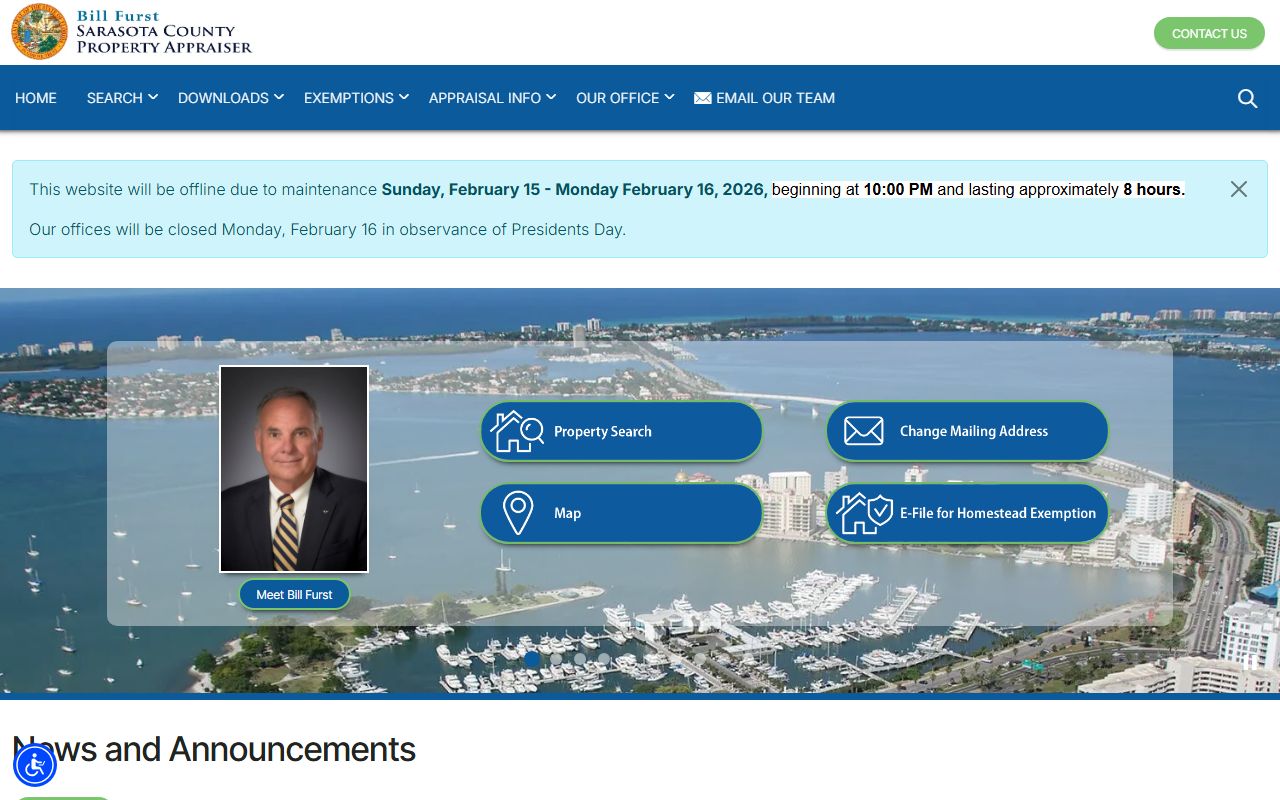
The appraiser's site is the main starting point for any Sarasota County property tax records search.
The Florida DOR Property Tax Oversight page provides broader context on how Florida's property tax system works statewide. All Sarasota County property tax assessments are conducted under the same statutory framework that applies to every other Florida county.
The Florida DOR Property Tax Oversight page explains the statewide rules that govern how county appraisers like Sarasota County assess property.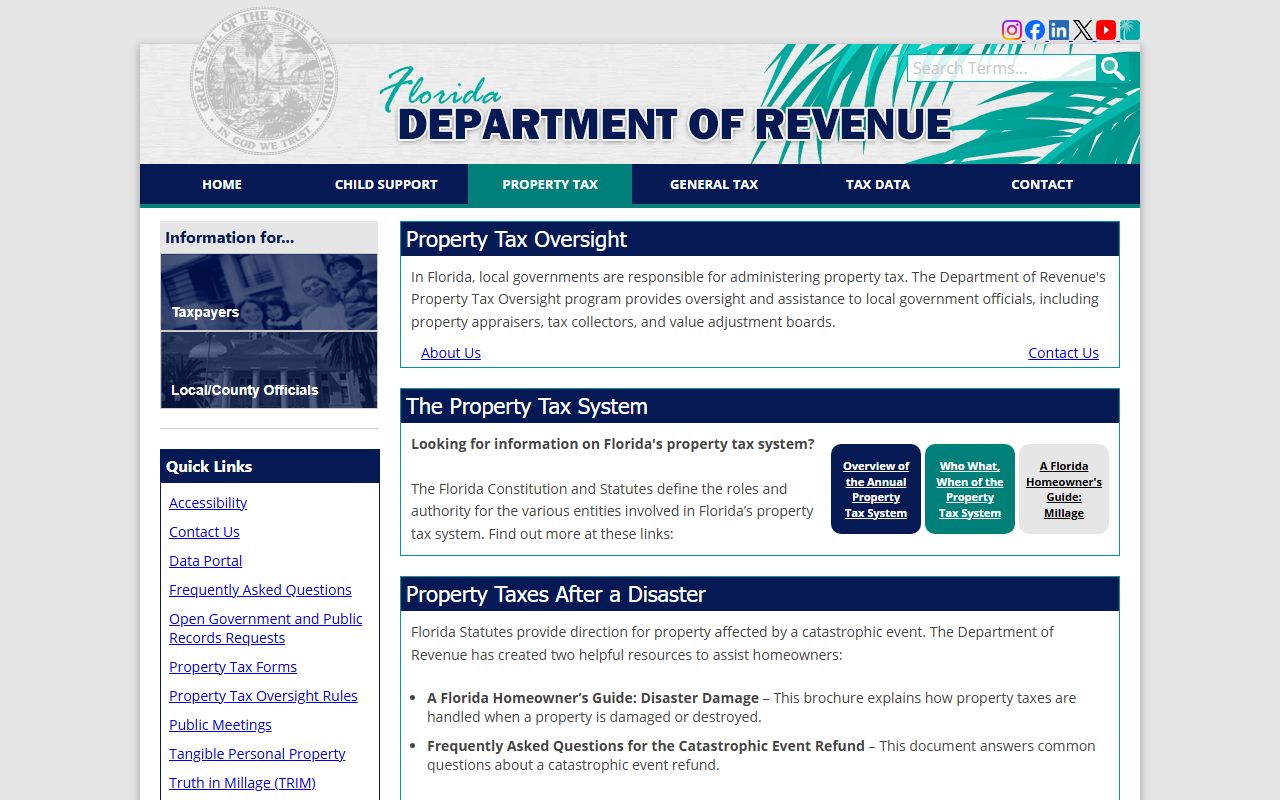
The DOR site is a reliable reference for state-level rules and how they apply to all Florida counties including Sarasota.
Note: Sarasota County's strong real estate market means just values can move significantly from year to year. Homestead properties are protected from large tax increases by the Save Our Homes cap, but non-homestead properties can see assessed value increases of up to 10% per year under Florida law.
Tax Billing and Collection in Sarasota County
The Sarasota County Tax Collector is at 101 South Washington Blvd., Sarasota, FL 34236-6993. Phone: (941) 861-8300. Fax: (941) 861-8353. The collector bills and collects property taxes for all parcels in the county. Tax bills go out in November each year, reflecting the taxable value from the property roll, adjusted for exemptions, multiplied by the combined millage rates from the county, the school board, and any applicable special districts.
Florida's early payment discount applies to all Sarasota County tax bills. Pay in November and receive a 4% discount off the face amount. The discount is 3% in December, 2% in January, and 1% in February. Taxes not paid by March 31 are delinquent. After that date, interest begins to accrue and the delinquent tax process under Chapter 197, Florida Statutes takes effect. The collector holds a tax certificate sale in June, at which investors bid on the right to pay the outstanding taxes and earn interest on the certificates they receive.
If a property owner does not redeem a tax certificate within two years by paying the taxes plus interest, the certificate holder can apply for a tax deed. That process can lead to a public sale of the property to recover the unpaid taxes. This is an avoidable outcome. Paying on time, or enrolling in the installment plan, keeps the property clear of tax certificate issues.
How to Search Sarasota County Property Tax Records
Start on the Sarasota County Property Appraiser website. The search tool lets you look up any parcel by owner name, property address, or parcel ID. The record shows the full assessment: just value, assessed value, taxable value, exemptions, land data, building data, and a history of all recorded sales. This is the right tool for assessment-related questions about any specific parcel in the county.
For tax bill data, what is owed, whether a payment was made, or the history of bills, use the Sarasota County Tax Collector's search tool. Enter the parcel ID or property address to pull up billing records and payment status. Together, the two databases give a complete picture of any Sarasota County property's tax status.
For aggregate or bulk data, the Florida DOR data portal offers downloadable county-level property tax files. These are useful for researchers, lenders, and investors who need data on multiple parcels or county-level trends. The portal is free and updated annually.
All Sarasota County property tax records are public under Chapter 119, Florida Statutes. Anyone can search or request these records without providing ID or a reason. The core data, ownership, assessed values, tax amounts, and payment history, is fully open.
Property Tax Exemptions in Sarasota County
Florida exemptions apply to qualifying Sarasota County parcels. The homestead exemption is the most commonly claimed. A primary residence can have its assessed value reduced by up to $50,000. The first $25,000 applies to all taxing authorities. The second $25,000 reduces assessed value between $50,000 and $75,000 for all authorities except the school board. Applications must be filed by March 1. Late applications are not accepted absent extraordinary circumstances.
Homestead also triggers the Save Our Homes cap. After the first year of homestead, the annual increase in a property's assessed value is limited to 3% or the prior year's inflation rate, whichever is lower. The cap is established in Chapter 193, Florida Statutes. In Sarasota County, where real estate values have risen sharply in recent years, the cap can generate a large gap between just value and assessed value for long-term homeowners. That gap reduces the taxable value and cuts the tax bill. When a property sells, the cap resets for the new owner.
Other exemptions available in Sarasota County include the senior low-income exemption for residents over 65 who meet income thresholds, veteran exemptions, disability exemptions, and the widow/widower exemption. Each has its own eligibility criteria and application requirements. All applications go to the Property Appraiser's office. The full framework for Florida property tax exemptions is in Chapter 196, Florida Statutes.
Business owners in Sarasota County with tangible personal property used in a business must file a TPP return with the appraiser by April 1. Filing on time preserves the $25,000 TPP exemption. Missing the April 1 deadline results in a penalty and forfeiture of the exemption for that tax year.
Note: If you are moving your homestead from one Florida property to another, ask the appraiser's office about portability. Up to $500,000 of your existing SOH benefit can be transferred to the new homestead. Apply for portability at the same time you apply for homestead on the new property.
Appealing a Sarasota County Property Assessment
Florida gives property owners in Sarasota County the right to challenge any assessed value they believe is too high. The appeal process begins with the TRIM notice, Truth in Millage, mailed by the Property Appraiser each summer. The notice shows your proposed assessed value and estimated taxes for the coming year. You have 25 days from the TRIM mailing date to file a petition with the Value Adjustment Board.
Before filing, contact the appraiser's office directly. Bring comparable sales, similar properties that sold near the January 1 assessment date, along with any evidence of condition problems or errors in the property data. If the appraiser's record contains mistakes, the office may correct the value informally without requiring a formal hearing. This is the fastest and simplest path to a resolution.
If the informal review doesn't work, file a VAB petition. The appeal is governed by Chapter 194, Florida Statutes. A special magistrate will hold a hearing, review both sides of the evidence, and make a recommendation. The board votes to accept or reject the recommendation. You can still go to circuit court if the board rules against you, though most disputes resolve at the VAB level. You do not need an attorney for a VAB hearing, though commercial property owners often hire one for larger appeals.
Pay at least the undisputed portion of your tax bill while the appeal is pending. Taxes accrue interest and penalties regardless of any appeal in progress.
Payment Options for Sarasota County Property Taxes
The Sarasota County Tax Collector at 101 South Washington Blvd. accepts payment in person, by mail, and online. Online payments go through the collector's web portal and typically accept major credit cards and e-checks. Convenience fees may apply to card payments. Mailed checks go to the main office at 101 South Washington Blvd., Sarasota, FL 34236-6993. Contact the office at (941) 861-8300 for current branch locations and hours.
The quarterly installment plan lets property owners pay throughout the year rather than all at once in November. Sign up in the spring. Installments come due in June, September, December, and March. Each payment earns a discount. This plan is especially useful for fixed-income owners who prefer to spread out the cost across the year.
After March 31, taxes are delinquent. Interest starts immediately. The June tax certificate sale follows. Once a certificate is sold, the property owner must redeem it within two years. If they don't, the certificate holder can apply for a tax deed and eventually force a public sale. Paying on time, or using the installment plan, avoids this entirely.
Public Records Access in Sarasota County
Florida's public records law makes almost all government records open to anyone. Under Chapter 119, Florida Statutes, Sarasota County property tax records, assessment rolls, tax rolls, ownership data, exemption files, and payment history, are all public. You do not need to be a Florida resident. You do not need to show ID or explain your purpose. The appraiser and collector websites provide free online access to most data. For records not available online, older assessments, certified copies, or bulk data files, submit a written request to the appropriate office. Staff must respond in a reasonable time. Fees may apply to large requests or for copies that require significant staff time, but the records themselves remain public by law.
Cities in Sarasota County
Sarasota County includes the cities of Sarasota, North Port, and Venice, along with smaller communities. North Port is the only city in the county above the 75,000-population threshold and has its own dedicated page. All Sarasota County property tax records, regardless of city, are managed by the County Property Appraiser and Tax Collector. You can look up any parcel on the appraiser's website by address, owner name, or parcel ID.