
De Soto County Property Tax Records
De Soto County property tax records are maintained by the Property Appraiser and Tax Collector, both based in Arcadia. The appraiser values every parcel in the county as of January 1 each year, covering residential homes, agricultural tracts, commercial properties, and vacant land throughout this rural south-central Florida county. This page explains how to search De Soto County tax records, understand your assessment, apply for available exemptions, and manage your annual tax bill through the county's official offices.
De Soto County Quick Facts
De Soto County Property Appraiser
The De Soto County Property Appraiser's mailing address is P.O. Box 729, Arcadia, FL 34265. Phone: (863) 993-4861. Fax: (863) 993-4863. The office website is at desotopa.com. The property appraiser is an elected official who independently values all real and personal property in De Soto County as of January 1 of each tax year. The appraiser does not set tax rates, that is the job of the county commission and other taxing authorities, but the assessed value the appraiser sets directly drives the tax bill each property owner receives.
De Soto County is largely agricultural. The Peace River runs through it, and a significant portion of the county's land base is in citrus groves, cattle ranches, and row crop operations. Agricultural land is assessed at its agricultural use value under Florida's classified-use assessment system, not at its full market value. That classification must be applied for and renewed. If a property loses its agricultural classification, the value can jump substantially.
For residential and commercial properties, the appraiser uses comparable sales data gathered from the county's Multiple Listing Service records, deed transfers, and other documented transactions. In a smaller county like De Soto, comparable sales may be less frequent than in larger metro counties, which can make individual assessments harder to verify. That makes it even more important to review your TRIM notice each August and contact the appraiser's office if the value looks off.
The Florida DOR provides oversight of all county property appraisers and lists county contacts at floridarevenue.com/property/Pages/LocalOfficials.aspx.
The De Soto County Property Appraiser's website provides online parcel search tools and assessment data for all properties in the county.
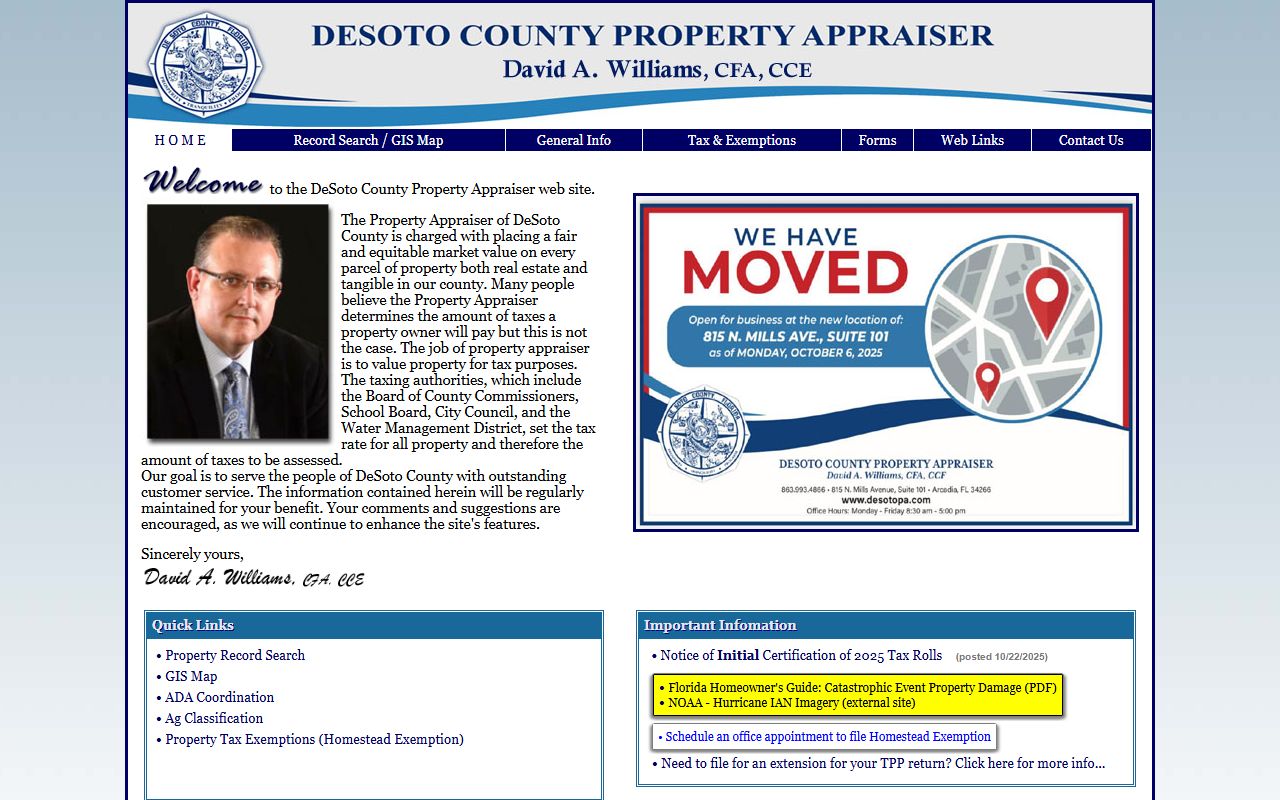
The site allows owner name, address, and parcel number searches and includes property maps and assessment histories.
De Soto County Tax Collector
The Tax Collector's mailing address is P.O. Box 729, Arcadia, FL 34265. Phone: (863) 993-4861. Fax: (863) 993-4863. The collector is a separate elected official from the appraiser and operates with a distinct role. Once the appraiser certifies the tax roll each October, the collector mails property tax bills by November 1. The full amount is due by March 31 without penalty.
Early payment earns a discount. November payment gets 4% off. December saves 3%. January is 2%. February saves 1%. Nothing after March 31. Delinquent accounts face a certificate sale in late spring. Investors buy the certificates, pay the overdue taxes, and earn interest until the property owner redeems the certificate. If the certificate is not redeemed within two years, the investor can apply for a tax deed and initiate a process that can lead to forced sale of the property.
The Tax Collector also manages vehicle registrations, driver license transactions, and hunting and fishing licenses. For property tax questions, contact the collector for billing amounts, payment confirmations, and delinquency status. For anything about assessed value or exemptions, the Property Appraiser's office is the right contact. The two offices serve very different functions even though they often share address information and phone systems in smaller counties.
Note: Confirm the physical office address before visiting, as the P.O. Box is used for mailed payments only. The street address for in-person visits is listed on the Tax Collector's official website.
How to Search De Soto County Property Tax Records
The Property Appraiser's website at desotopa.com is the starting point for any parcel search in De Soto County. You can look up properties by owner name, street address, or parcel identification number. The parcel number is the most precise option. It is listed on tax bills, deeds, and title reports. If you do not have the parcel number, address searches usually work for properties with a standard street address. Rural parcels with section-township-range legal descriptions may require a legal description search or a call to the office.
Each parcel record shows the property owner, mailing address, property type code, land value, building value, total assessed value, applied exemptions, and the legal description. If the property has sold recently, the sale price and date appear in the record. That sales data feeds into the appraiser's comparable analysis for nearby similar properties. Building sketches and aerial photography are often included for residential parcels.
Tax payment data comes from the Tax Collector's system. Search by parcel number to see the current bill, prior payments, and any delinquency or certificate status. All De Soto County property tax records are public under Chapter 119, Florida Statutes. You do not need to be the property owner or give a reason to view the records.
Bulk data for De Soto County is available through the Florida Department of Revenue's data portal at floridarevenue.com/property/Pages/DataPortal.aspx.
Property Tax Exemptions in De Soto County
De Soto County homeowners who use their property as a primary Florida residence can apply for the homestead exemption. It removes up to $50,000 from the assessed value for tax calculation purposes. The first $25,000 applies against all taxing authorities, including schools. The second $25,000 only applies to non-school taxes and only if the property's assessed value falls between $50,000 and $75,000. The March 1 deadline is firm. Miss it and you wait another year.
Agricultural classification is critically important in De Soto County. A significant portion of county land qualifies for agricultural use assessment, which values the property based on its income-producing ability as farm or ranch land, not on what it might sell for to a developer. The difference can be dramatic. Property that would sell for $2 million as a subdivision site might be assessed at $200,000 under agricultural classification. Owners of agricultural land must apply for this classification and demonstrate active agricultural use. Chapter 193, Florida Statutes governs both agricultural classification and the Save Our Homes cap that protects homestead-exempt properties.
Other available exemptions include veteran disability, total and permanent disability, widow and widower, deployed military, and the senior citizen low-income exemption. Each requires documentation. Contact the De Soto County Property Appraiser's office at (863) 993-4861 to confirm what is needed for the exemption you want to apply for.
Business owners must file a tangible personal property return by April 1 to preserve the $25,000 TPP exemption. See Chapter 196, Florida Statutes for the full set of available exemptions and their requirements.
Appealing Your De Soto County Assessment
If your TRIM notice shows a value that does not match the market, call the De Soto County Property Appraiser's office first. In a smaller county, the process of reaching a staff member and discussing your specific parcel is often more direct than in larger offices. Bring your evidence: comparable sales from your area, a private appraisal, or documentation of any error in the property record. Data errors can be corrected quickly and informally.
If you cannot reach an agreement with the appraiser, file a petition with the Value Adjustment Board within 25 days of the TRIM mailing date. That date appears on the TRIM notice. The VAB assigns a special magistrate to hear the case. You present your evidence. The appraiser presents theirs. The magistrate recommends a value to the full board.
For rural and agricultural properties, the evidence you need is different from what works for residential appeals. For agricultural land, you need to show that the agricultural use is real and active, and that comparable agricultural tracts in the area support a lower value. For residential, you need comparable home sales near your property from around January 1 of the tax year. Chapter 194, Florida Statutes governs the VAB process statewide.
Always pay on time regardless of any pending VAB petition. You can receive a refund if you win. You cannot undo a delinquency by winning later.
Paying De Soto County Property Taxes
Tax bills go out November 1. The deadline without penalty is March 31. Pay in November for 4% off. Each month after that, the discount drops one point. February gets you 1%. Nothing after March. The Tax Collector in Arcadia accepts in-person payments, mail-in checks, and in some cases online payments. Check the current options on the Tax Collector's website or by calling (863) 993-4861.
The installment plan lets you spread payments across four quarters. Enroll by April 30 to participate for the following tax year. The plan has its own discount schedule for each installment. It can help property owners manage cash flow on large annual bills, particularly those with multiple parcels or agricultural holdings. The Florida Tax Collectors Association at floridataxcollectors.com has information on statewide payment practices.
Delinquent accounts face a certificate sale in late spring or early summer. When a certificate is sold, the investor pays the overdue amount and earns interest at the bid rate. The owner must pay back the investor, with interest, to redeem the certificate and clear the lien on the property. Chapter 197, Florida Statutes governs the delinquency process, certificate sales, and tax deed proceedings.
De Soto County Property Records and Public Access
De Soto County property tax records are public documents under Chapter 119, Florida Statutes. Anyone can request and receive assessed values, ownership information, parcel descriptions, sales histories, exemption types, and tax payment records. No stated purpose is needed. The records are public by default.
Protected information includes Social Security numbers, personal income data, financial documents submitted to qualify for exemptions, and bank account details used for electronic payments. The public record will show what type of exemption is on file, but the supporting financial documents used to qualify are not available for public review.
To access De Soto County property tax records, use the appraiser's online database, call or visit the offices in Arcadia, or submit a written public records request. Copies may carry a nominal reproduction cost. The Florida Department of Revenue provides forms and guidance at floridarevenue.com/property/Pages/Forms.aspx. The Professional Association of Florida Appraisers at paaf.us offers resources on how Florida's appraisal system works.
The Florida Department of Revenue's data portal offers bulk downloads of county property data, including De Soto County assessment rolls.
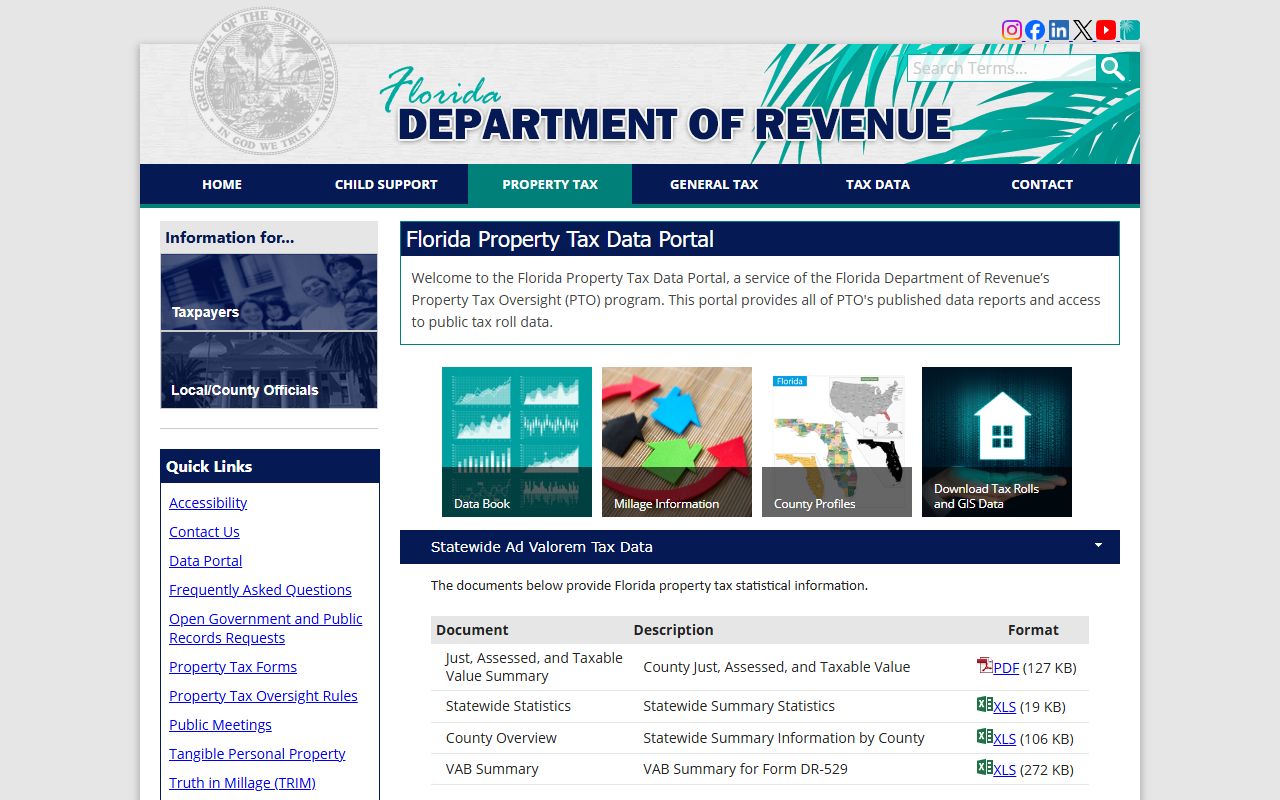
This resource is useful for researchers, assessors, and anyone who needs access to multiple parcels of De Soto County property data at once.
Cities in De Soto County
Arcadia is the county seat and the only incorporated city in De Soto County. It is located in the central part of the county along the Peace River. Other unincorporated communities include Nocatee, which sits at the eastern edge of the county near the Highlands County line. None of De Soto County's communities exceed 75,000 residents, so no dedicated city-level pages are available. All property tax records for the county, including Arcadia properties, are handled through the county-level offices described above.