
Pinellas County Property Tax Records
Pinellas County property tax records are public documents maintained by the Property Appraiser and Tax Collector offices, both headquartered in Clearwater. These records cover every parcel in the county, from beachfront condos to commercial buildings, and include assessed values, ownership data, exemption status, and tax payment history. This page covers how to search those records, how exemptions work, and how to challenge an assessment you believe is wrong.
Pinellas County Quick Facts
Pinellas County Property Appraiser
The Pinellas County Property Appraiser is located at 315 Court Street, Clearwater, FL 33756. Phone: (727) 464-3207. Fax: (727) 464-3798. The appraiser is elected and responsible for valuing all real and personal property in Pinellas County as of January 1 each year. That annual valuation drives the tax bill each fall. The appraiser does not set tax rates and does not collect taxes, those roles belong to the taxing authorities and the Tax Collector.
Pinellas County is one of Florida's most densely populated counties. The property roll includes a large number of residential condominiums, single-family homes, commercial parcels, and waterfront properties. The appraiser's office uses mass appraisal methods consistent with Florida Department of Revenue guidelines. Values are derived from comparable sales, property characteristics, and physical condition data. Under Chapter 192, Florida Statutes, all parcels must be assessed at just value each year.
The Pinellas County Property Appraiser website provides free online access to the county property roll. You can search by owner name, property address, or parcel identification number. Search results show assessed value, just value, taxable value, exemptions, land and building detail, and sales history. The site also provides GIS mapping and aerial views of parcels.
The Pinellas County Property Appraiser website gives you free access to all parcel data and tax records in the county.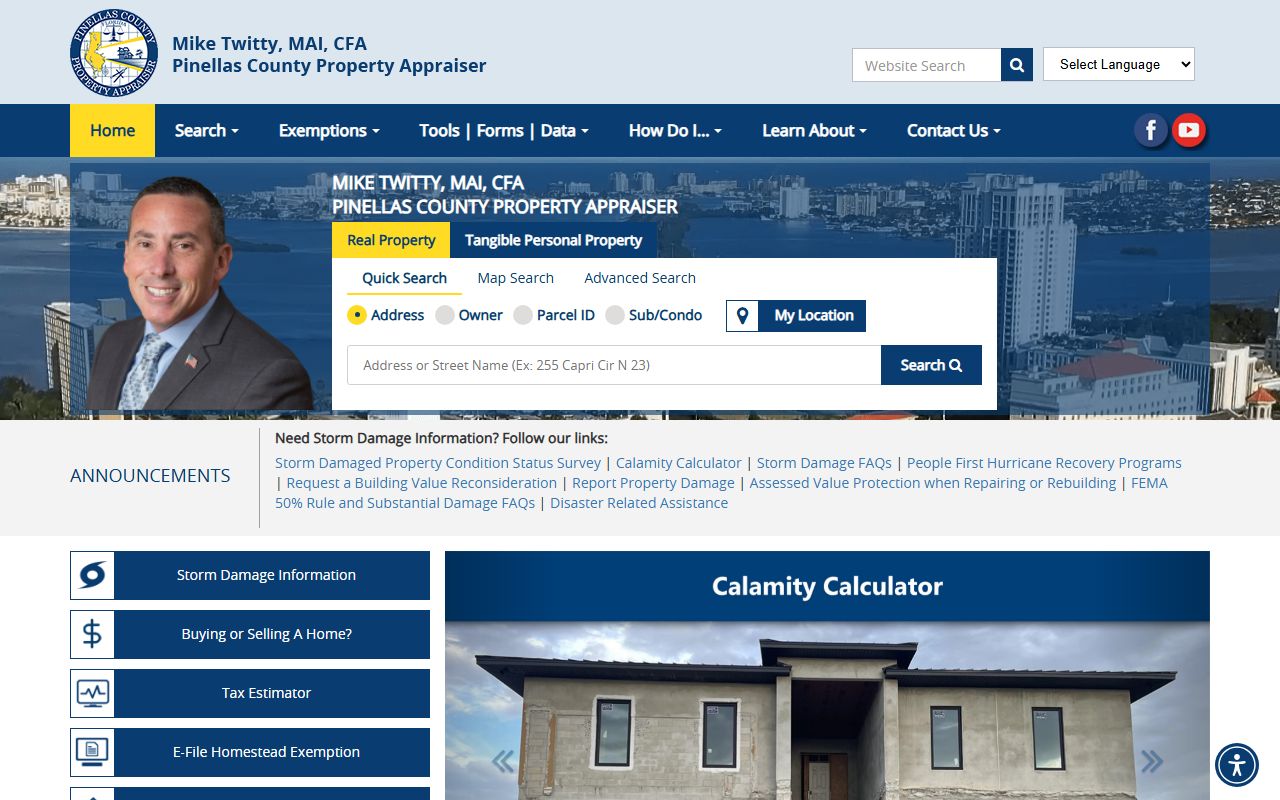
The appraiser's website is where most searches for Pinellas County property tax records start.
The Florida Department of Revenue provides oversight for county appraisers statewide. You can find guidance on how assessments work at the DOR Property Tax Oversight page. The same rules govern all 67 Florida counties, including Pinellas.
Tax Billing and Collection in Pinellas County
The Pinellas County Tax Collector handles billing, payment, and enforcement. The mailing address is P.O. Box 6288, Clearwater, FL 33758. Phone: (727) 464-7777. Fax: (727) 453-3784. The collector mails tax bills in November. Bills reflect the taxable value set by the appraiser, adjusted for exemptions, multiplied by the combined millage rates from county government, the school board, and any applicable special taxing districts.
Florida's discount schedule for early payment applies to Pinellas County bills. Pay in November and get 4% off. The discount drops to 3% in December, 2% in January, and 1% in February. Taxes not paid by March 31 become delinquent. After that, interest accrues and the county moves toward a tax certificate sale in June. That process is governed by Chapter 197, Florida Statutes.
At the tax certificate sale, investors bid on the right to pay the delinquent taxes. The winning bidder pays the taxes and receives a certificate that earns interest. The property owner must redeem the certificate within two years or the certificate holder can apply for a tax deed, which leads to a public sale. Staying current on payments prevents this entire chain of events.
The Florida DOR directory of local property officials lists contact information for all county tax collectors if you need to verify Pinellas County office locations or hours.
The Florida DOR directory lists all county property appraisers and tax collectors with phone numbers and office addresses.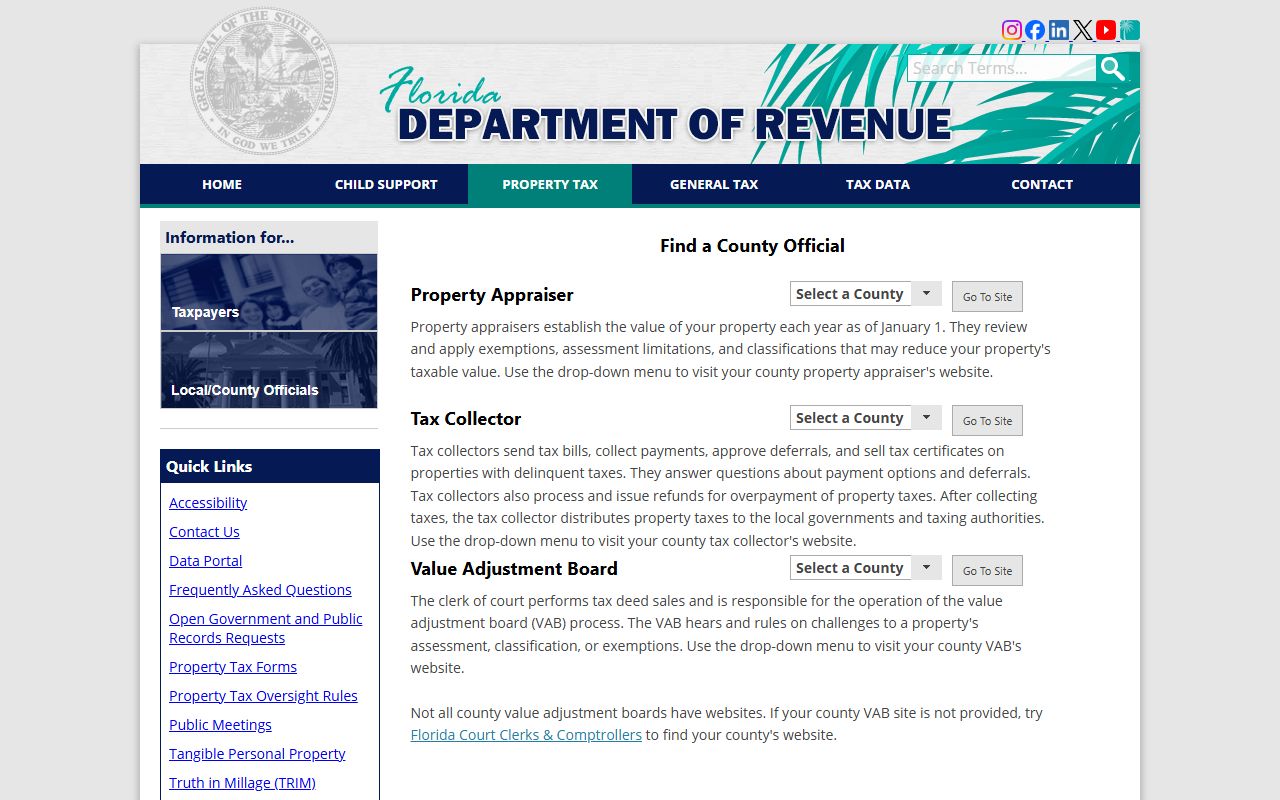
The DOR directory is a quick way to confirm contact information for any Florida county tax office.
How to Search Pinellas County Property Tax Records
The Pinellas County Property Appraiser site is the main search tool for parcel data. Search by owner name, property address, or parcel ID. Results include the full assessment record: just value, assessed value, taxable value, exemptions, and sales history. This is the right tool when you need assessment information for a specific parcel.
For tax bill data, current balance, payment history, or whether a bill was paid, use the Pinellas County Tax Collector's online system. Enter the parcel ID or property address to pull up billing records. Together, the appraiser and collector databases give a complete view of any parcel's property tax status in the county.
If you need broader data, county-level aggregate files or statewide comparisons, the Florida DOR data portal provides downloadable property tax data for all 67 counties. Researchers, appraisers, and investors use this resource to work with bulk data rather than individual parcel lookups.
All Pinellas County property tax records are public under Chapter 119, Florida Statutes. Anyone can request or search these records. No reason is required. The core data, ownership, assessed value, tax amounts, and payment history, is fully open.
Note: Parcel ID numbers in Pinellas County follow a specific format. Using the full parcel ID in a search returns results faster than searching by name or address.
Property Tax Exemptions in Pinellas County
Florida offers several exemptions that apply to qualifying Pinellas County parcels. Homestead is the most common. A primary residence qualifies for up to $50,000 off the assessed value. The first $25,000 applies to all taxing authorities. The second $25,000 applies to assessed value between $50,000 and $75,000 and covers all authorities except the school board. Applications are due by March 1.
Homestead also triggers the Save Our Homes cap. After the first year of homestead, annual increases in assessed value are capped at 3% or the prior year's inflation rate, whichever is lower. This protection is set out in Chapter 193, Florida Statutes. In a county like Pinellas, where property values have risen sharply in recent years, the cap can produce a large difference between just value and assessed value, meaningfully reducing a homeowner's tax bill over time. When the property sells, the cap resets for the new owner.
Other exemptions available in Pinellas County include the senior low-income exemption for residents over 65 who meet income thresholds, veteran exemptions, disability exemptions, and the widower/widow exemption. Each has its own eligibility criteria and deadline. Applications go to the Property Appraiser's office. Full exemption rules are in Chapter 196, Florida Statutes.
Business owners with tangible personal property (equipment, furniture, inventory) used in a business must file a TPP return with the appraiser by April 1. Filing on time preserves the $25,000 TPP exemption. Missing the deadline costs you that exemption for that year.
Appealing Your Pinellas County Assessment
Each summer, the Property Appraiser mails a TRIM notice to every property owner in Pinellas County. TRIM stands for Truth in Millage. The notice shows your proposed assessed value and what your taxes will look like based on that value and the current millage rates. You have 25 days from the mailing of the TRIM notice to file a petition with the Value Adjustment Board.
Many owners talk to the appraiser's office first. That conversation can clear up misunderstandings about how the value was set. If you can show that the appraiser used incorrect data, wrong square footage, wrong condition rating, or comparable sales that don't actually match your property, the office may correct the value informally. This avoids the need for a formal hearing.
If the informal conversation doesn't resolve the issue, file a VAB petition. You will get a scheduled hearing before a special magistrate. Bring your evidence: comparable sales from nearby properties, photos of condition problems, any professional appraisal you have. The magistrate reviews both sides and makes a recommendation. The board votes to accept or reject it. VAB appeals are governed by Chapter 194, Florida Statutes.
Circuit court is still an option if the board rules against you, but most disputes resolve at the VAB level. Filing fees for VAB petitions vary by parcel type. You do not need an attorney, though commercial property owners often use one for larger appeals.
Payment Options for Pinellas County Taxes
The Pinellas County Tax Collector accepts online payments, in-person payments at office locations, and mailed checks. Online payments go through the collector's web portal and accept major credit cards and e-checks. Card payments typically carry a convenience fee. Mailed checks should go to P.O. Box 6288, Clearwater, FL 33758.
The quarterly installment plan is available for owners who want to spread payment over the year. Sign-up happens in the spring before the bill year. Installments come due in June, September, December, and March. Each payment earns a discount. If you own property in Pinellas and find the November lump-sum payment difficult, the installment plan is worth setting up before the spring deadline.
Taxes not paid by March 31 are delinquent. The collector moves toward a tax certificate sale in June. Investors pay the overdue taxes and receive a certificate. Two years of nonredemption allows certificate holders to begin tax deed proceedings. The property can eventually be sold at public auction to recover the unpaid taxes. This outcome is avoidable by keeping payments current.
Public Records Access in Pinellas County
Florida's public records law under Chapter 119 makes nearly all government records open to anyone. Pinellas County property tax records, assessment rolls, tax rolls, exemption filings, and payment history, are all public. You don't need to be a county resident. You don't need a lawyer. You don't need to give a reason.
The appraiser and collector websites cover most needs online at no cost. Records not available through the portals, older files, certified copies, or bulk data, can be requested in writing. The offices must respond in a reasonable timeframe. Staff time and copy fees may apply for large requests. But the records are public and accessible by law.
Cities in Pinellas County
Pinellas County is home to several major cities, all served by the same county Property Appraiser and Tax Collector. Property tax records for every city in the county are part of the same county roll. City-specific detail is available on the pages below.