
Gulf County Property Tax Records
Gulf County property tax records are public documents maintained by the Property Appraiser and Tax Collector offices in Port St. Joe, Florida. These records cover all real property in the county, including parcels along the Gulf Coast shoreline, timberland tracts, and rural acreage, and they are open to anyone who wants to look them up.
Gulf County Quick Facts
Gulf County Property Appraiser
The Gulf County Property Appraiser operates out of Port St. Joe and is responsible for setting the assessed value of every parcel in the county as of January 1 each year. The office is located at 1000 Cecil G. Costin Sr. Blvd., Room 100, Port St. Joe, FL 32456. You can reach them by phone at (850) 229-6116 or by fax at (850) 229-9224.
The appraiser's office handles far more than just setting values. They process homestead exemption applications, track ownership changes, maintain parcel maps, and keep records of every property classification in the county, from residential lots to commercial tracts to agricultural land. Their database is the starting point for nearly all Gulf County property tax records research.
The official website for the Gulf County Property Appraiser is gulfpa.com. It offers online search tools that let you look up parcels by owner name, address, or parcel ID. The site also shows current assessed values, tax history, and exemption status. It's a good first stop.
The screenshot below shows the Gulf County Property Appraiser website, where you can search Gulf County property tax records and access parcel detail pages.
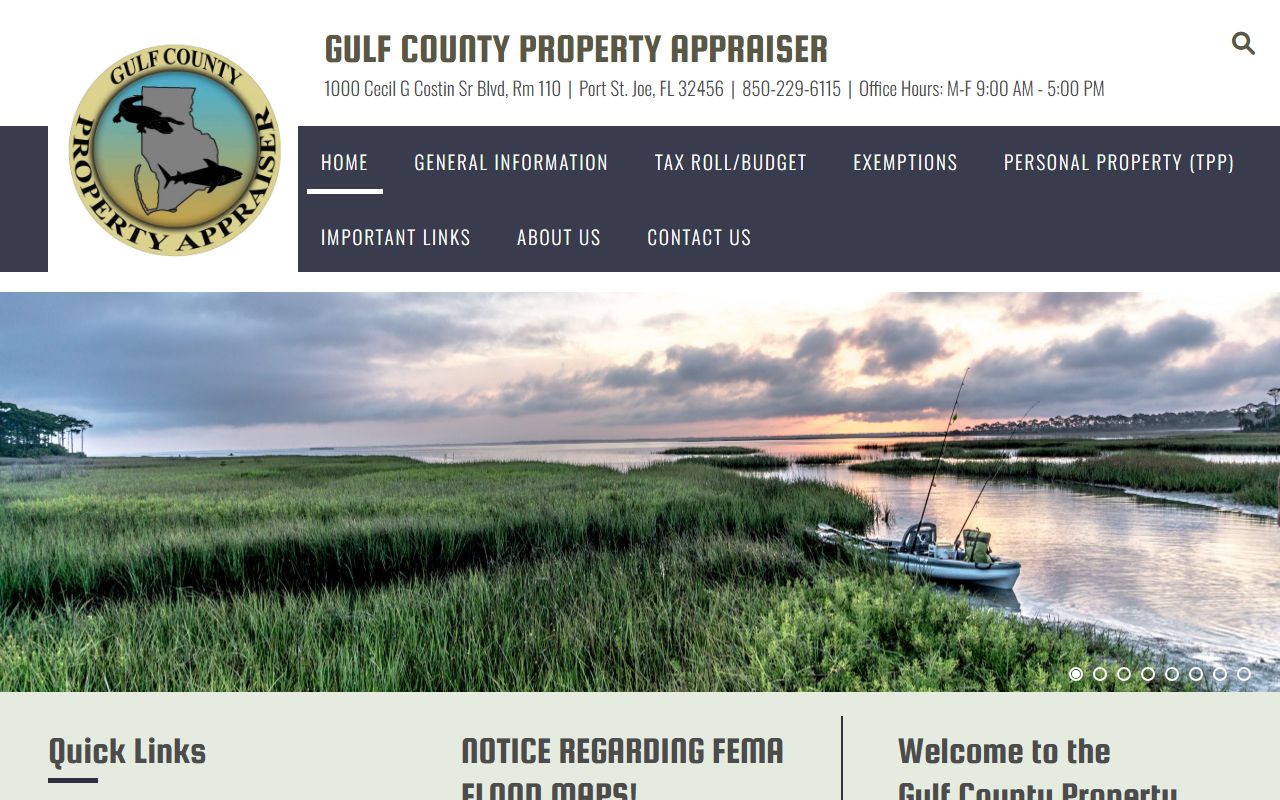
The site is updated regularly as ownership transfers and assessment changes are processed throughout the year.
Gulf County Tax Collector
Once the Property Appraiser sets values and exemptions are applied, the Tax Collector takes over. They send out TRIM notices, generate tax bills, collect payments, and handle delinquent tax certificates. The Tax Collector's office is at the same address as the appraiser: 1000 Cecil G. Costin Sr. Blvd., Room 100, Port St. Joe, FL 32456. Their phone number is (850) 229-6116.
Tax bills go out in November each year. Florida law gives property owners a discount if they pay early. Pay in November and you get 4% off. December is 3%, January is 2%, and February is 1%. Pay by March 31 and there is no discount but also no penalty. On April 1, unpaid taxes become delinquent under Florida Statutes Chapter 197, and interest and fees start to add up fast.
The Tax Collector's office can help if you need a copy of a paid tax receipt, a current tax bill, or information about a delinquent account. They also process installment payment plans for qualifying property owners who want to spread payments across four quarters rather than paying all at once in late fall.
You can also find information about Gulf County tax collection through the Florida Tax Collectors Association, which links to county-level offices across the state.
Search Gulf County Property Tax Records Online
The fastest way to search Gulf County property tax records is through the Property Appraiser's online portal at gulfpa.com. You can search by owner name, property address, or parcel identification number. Results show you assessed value, taxable value, exemptions, land size, building details, and tax history going back several years.
The Florida Department of Revenue also operates a statewide data portal at floridarevenue.com that includes Gulf County assessment data. This resource is useful if you want to download bulk data files or compare values across multiple properties. The portal is free and does not require an account.
For parcel maps and GIS data, the appraiser's site may include a mapping tool. If not, the county's planning or GIS department sometimes maintains separate map layers that cross-reference with property records. Either way, the parcel ID from the appraiser search will help you track down everything tied to a given piece of land.
Exemptions Available in Gulf County
Florida offers several property tax exemptions that reduce the taxable value of a property. The biggest one is the homestead exemption. If you own and live in your Gulf County home as your primary residence on January 1, you can apply for a $25,000 reduction in assessed value. A second $25,000 exemption applies to the portion of value between $50,000 and $75,000 for non-school taxes. That's a potential $50,000 reduction total, and it makes a real difference on the tax bill.
The deadline to apply for a homestead exemption is March 1. If you miss that date, you'll need to wait until the following year. Applications go through the Property Appraiser's office, and you'll need to show proof of ownership and Florida residency. The Save Our Homes cap, sometimes called the SOH cap, limits increases in the assessed value of a homestead property to 3% per year or the rate of inflation, whichever is lower. Over time, this can create a significant gap between assessed value and actual market value.
Other exemptions include reductions for veterans with service-connected disabilities, widows and widowers, seniors with limited income, and blind or totally disabled residents. Each has its own eligibility rules. The Property Appraiser's office can walk you through what you qualify for. Details on exemption law are in Florida Statutes Chapter 196.
Tangible personal property, business equipment and furnishings, follows a different schedule. The TPP return deadline is April 1. Businesses that file late face penalties. The first $25,000 of TPP value is exempt for businesses that file on time.
Contesting Your Assessment in Gulf County
Property owners who think their assessed value is too high can challenge it. The process starts with a TRIM notice, Truth in Millage, which the Property Appraiser mails in August. This document shows the proposed assessment for the coming year and tells you how to object. If you think the number is wrong, act fast. The deadline to file a petition with the Value Adjustment Board is 25 days after the TRIM notice is mailed.
The Value Adjustment Board, or VAB, hears appeals from property owners who disagree with the appraiser's valuation or an exemption denial. The VAB is made up of county commissioners and school board members, with hearings conducted by a special magistrate. You do not need a lawyer to appear. You just need to present evidence that your property's assessed value does not match its market value as of January 1. Comparable sales, independent appraisals, and documentation of property condition all help.
The rules governing VAB petitions are in Florida Statutes Chapter 194. You can also find guidance from the Florida Department of Revenue at floridarevenue.com. Assessment methodology and what the appraiser must consider when valuing property falls under Chapter 193.
Paying Gulf County Property Taxes
Tax bills arrive in November. Most owners in Gulf County pay online, by mail, or in person at the Tax Collector's office on Cecil G. Costin Sr. Blvd. Online payment options typically accept credit cards and e-checks, though processing fees may apply for card payments. Mailed payments should be sent well before the end-of-month deadlines to ensure the payment is credited at the right discount rate.
If taxes go unpaid after March 31, they become delinquent on April 1. At that point the Tax Collector is required by state law to begin the tax certificate sale process. Tax certificates are sold to investors who pay the overdue taxes in exchange for a lien on the property. The investor earns interest, and the owner can redeem the certificate by repaying the investor plus that interest. If the certificate is not redeemed within two years, the certificate holder can apply for a tax deed, which can ultimately lead to the property being sold at public auction.
Property owners who are struggling to pay can look into the installment plan. You enroll by April 30 for the following year's taxes. Payments are split into four installments, June, September, December, and March. There is a small discount built into the installment plan as well.
Requesting Gulf County Property Tax Records
Florida's public records law, Chapter 119 of the Florida Statutes, gives anyone the right to inspect and copy government records, including property tax records. You do not need to be a Florida resident. You do not need to explain why you want the records. The law is broad and covers assessment rolls, tax bills, exemption files, and other documents held by the appraiser and tax collector.
Most Gulf County property records are available without a formal request, just search online. But if you need something that isn't on the website, such as older records, appeal files, or specific correspondence, you can submit a public records request to the appraiser's or tax collector's office directly. Contact them at (850) 229-6116. They are required to respond in a reasonable time and may charge a fee to cover copying costs.
The Florida Department of Revenue provides additional context on how public records requests work in the property tax context at floridarevenue.com. The professional appraisers' organization, PAAF, also offers guidance on how Florida's property appraisal system works statewide.
Cities in Gulf County
Gulf County's population is concentrated in small communities along the coast. Port St. Joe is the county seat. No city in Gulf County exceeds the population threshold for a dedicated records page.