
Find West Palm Beach Property Tax Records
West Palm Beach property tax records are kept by the Palm Beach County Property Appraiser and Tax Collector, both located in downtown West Palm Beach. As the county seat of Palm Beach County, West Palm Beach is home to both offices, making in-person access straightforward. All parcel records, assessed values, exemption data, and tax bills are public and available online at no cost.
West Palm Beach Quick Facts
Palm Beach County Property Appraiser
The Palm Beach County Property Appraiser, Dorothy Jacks, CFA, operates from 301 North Olive Avenue, 5th Floor, West Palm Beach, FL 33401. The main phone is 561.355.2866. This office values all real and personal property in Palm Beach County as of January 1 each year. That includes every residential, commercial, and agricultural parcel within West Palm Beach city limits, as well as properties across the rest of the county.
The appraiser's office maintains the official property roll. Each parcel entry includes the owner of record, legal description, land data, building characteristics, just value, assessed value, taxable value, and any exemptions that apply. The roll is updated continuously as deeds are recorded, permits are issued, and sales close. The appraiser uses mass appraisal methods following Florida Department of Revenue guidelines.
Search tools are available at the Palm Beach County Property Appraiser website. You can look up parcels by property address, owner name, or parcel control number. The advanced search at pbcpao.gov/AdvSearch gives more filter options for complex queries. The site shows assessed values, prior-year comparisons, sales history, and exemption detail for every parcel.
A GIS mapping tool at gis.pbcgov.org/papagis lets you view parcel boundaries on an aerial map. This is useful when you need to confirm exact parcel locations or boundaries. The map links back to the full parcel record on the appraiser's site.
The Florida DOR oversees all county appraisers. You can review statewide rules and policy at the DOR Property Tax Oversight page. Assessment standards are also in Chapter 193 of the Florida Statutes.
The Florida DOR Property Tax Oversight site explains statewide assessment rules and provides links to county offices.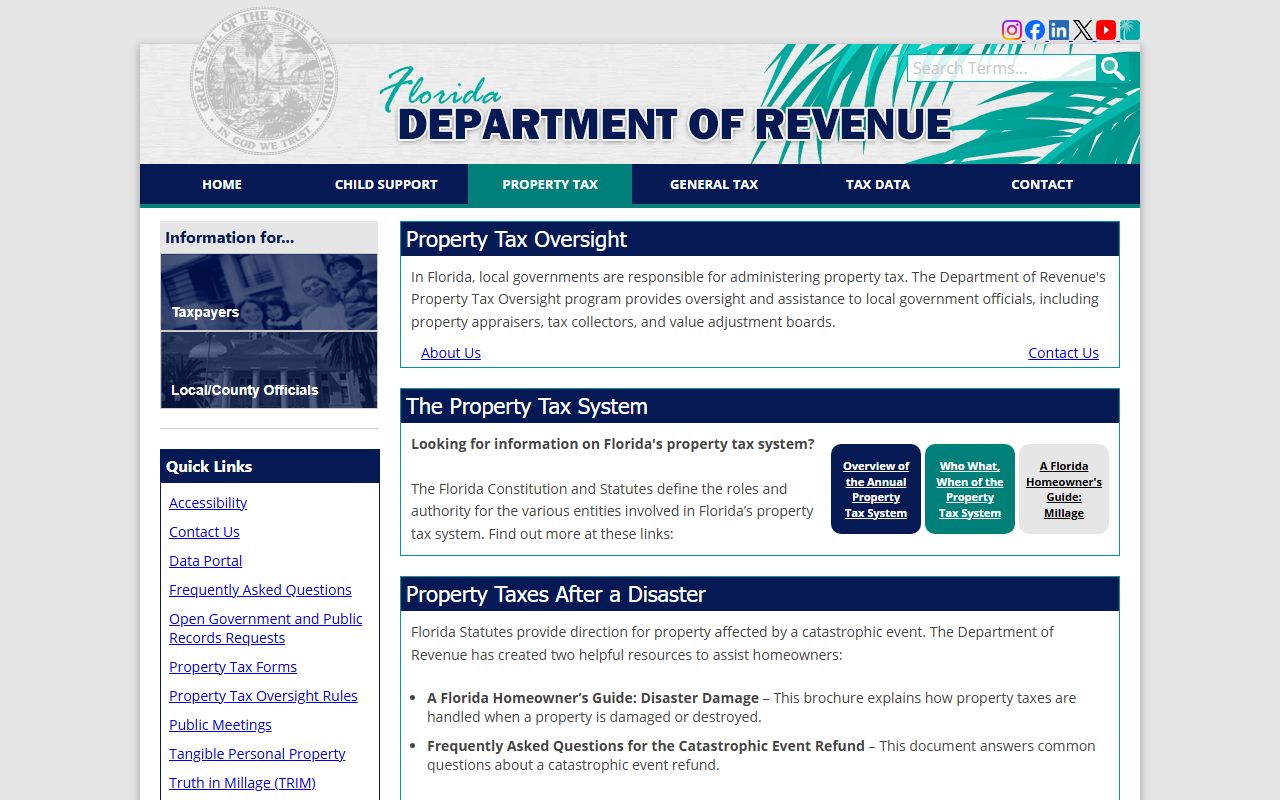
The DOR site is the central hub for understanding how Florida property tax works from assessment through collection.
Palm Beach County Tax Collector
Tax Collector Anne M. Gannon operates from 301 North Olive Avenue, 3rd Floor, West Palm Beach, FL 33401. The office phone is 561-355-2264. You can also reach the office by email at ClientAdvocate@pbctax.com. The Palm Beach County Tax Collector website handles online payments, balance lookups, and general tax billing information. Property tax payments can be made at pbctax.gov/property-tax.
Tax bills go out in November and cover the assessment made on January 1 of that year. The amount on your bill combines the taxable value set by the appraiser with millage rates adopted by all local taxing authorities. For West Palm Beach properties, this includes Palm Beach County, the school board, the City of West Palm Beach, and any special districts with taxing authority over your parcel. Each authority appears as a separate line on the bill.
Early payment earns a discount. November payments get 4% off. December earns 3%, January 2%, and February 1%. Taxes become delinquent after March 31. The certificate sale process that follows is governed by Chapter 197, Florida Statutes. Delinquent taxes are serious. Certificates can eventually lead to a tax deed sale if not redeemed.
In addition to online and in-person payment at the downtown office, the collector has branch locations in other parts of Palm Beach County. An installment plan lets you spread the annual bill over four quarterly payments. You must enroll in the spring before the tax year you want to use it for. The collector's site has enrollment details.
How to Search West Palm Beach Property Records
Start at the Palm Beach County Property Appraiser site. Search any West Palm Beach parcel by address or parcel control number. The results page shows the current and prior-year assessed values, just value, taxable value, land data, building data, and sales history. You also see which exemptions are active on the parcel. The site is free and requires no login.
For billing and payment status, go to the Tax Collector site. Enter the parcel control number to check what is owed, whether taxes are current, and the history of prior payments. These two searches together give a complete financial picture of any West Palm Beach property.
The Florida DOR's statewide property tax data portal provides downloadable bulk data by county. Use this if you need aggregated figures or want to compare Palm Beach County data to other counties across the state.
All records are public under Chapter 119, Florida Statutes. You do not need to be a resident. You do not need a stated reason. The only protected data is personal identifiers like Social Security numbers on exemption applications. Core property and tax data is fully open.
Exemptions for West Palm Beach Property Owners
Florida's homestead exemption reduces the assessed value of a primary residence by up to $50,000. The first $25,000 applies against every taxing authority. The second $25,000 applies to value between $50,000 and $75,000, but it does not count against school taxes. Combined with the Save Our Homes cap, homestead status can mean large long-term savings in a county where property values have climbed significantly.
The Save Our Homes cap limits assessed value increases to 3% per year or the rate of inflation, whichever is lower. This is codified in Chapter 193, Florida Statutes. In West Palm Beach, where market prices have risen sharply, the gap between just value and assessed value on homesteaded properties can be very large. New buyers should understand that this cap resets when a property changes hands.
Other available exemptions include the senior low-income exemption, veteran exemptions, disability exemptions, and surviving spouse exemptions. Applications go to the Palm Beach County Property Appraiser. Homestead applications can be filed online at the appraiser's e-file portal. The deadline for homestead and most exemptions is March 1. All exemption law is in Chapter 196, Florida Statutes.
Chapter 193 sets the rules for how Florida properties are assessed, including the Save Our Homes cap.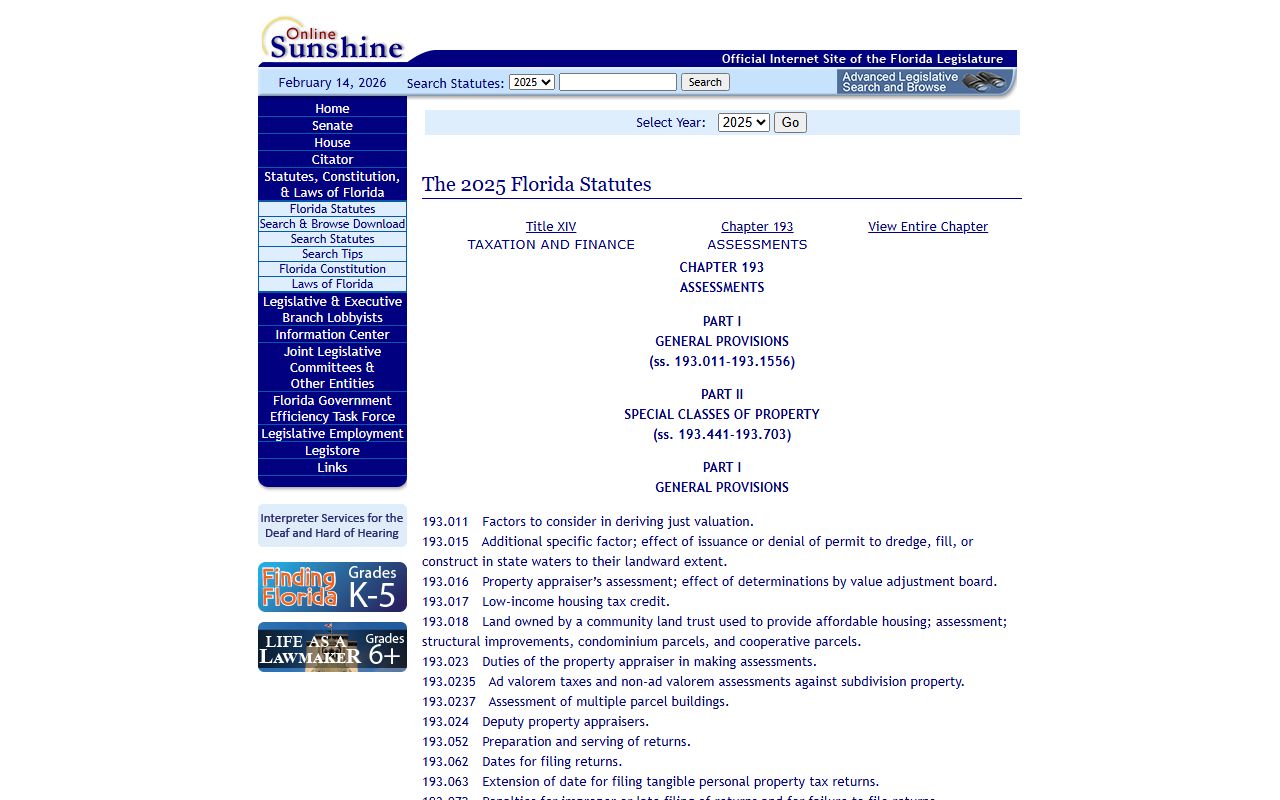
The statute covers the January 1 assessment date, valuation methods, and the annual cap on increases for homesteaded properties.
Appealing a West Palm Beach Assessment
Property owners who disagree with their assessed value can file a petition with the Palm Beach County Value Adjustment Board. The TRIM notice comes each summer and shows the proposed value and estimated tax. You have 25 days from the mailing date to file a petition. The filing fee is modest and varies by parcel type.
After filing, you get a hearing before a special magistrate. The magistrate reviews the appraiser's evidence and your evidence, then makes a recommendation. The VAB board votes on the recommendation. The process is governed by Chapter 194, Florida Statutes. You do not need a lawyer to file, though many commercial property owners use one.
Build your case with facts. Bring comparable sales from similar properties in West Palm Beach sold near the assessment date. Document any condition issues with photos. An independent appraisal is strong evidence for higher-value properties. The burden is on you to show the appraiser's number is wrong, so solid evidence matters more than just arguing the value feels too high.
Pay the undisputed portion of your tax bill during the appeal. Failing to pay can add penalties. If the VAB rules against you, you can still file a circuit court lawsuit, though most disputes are resolved at the VAB level without going that far.
Public Records Access and Florida Law
Palm Beach County property tax records are governed by Florida's public records law, Chapter 119. This law makes almost all government records open to anyone without restriction. Property owners, buyers, researchers, attorneys, and members of the public can all access parcel data, assessment history, and tax billing information without showing ID or stating a reason.
Sensitive personal data on exemption applications, such as Social Security numbers and bank account details, is protected. But the core records, including owner name, property address, assessed value, taxable value, sales history, and payment status, are fully public. Most of this data is available through the online portals maintained by the appraiser and tax collector at no cost.
For records not online, you can contact either office directly with a written request. The office must respond within a reasonable time. Fees may apply for copies or large data extracts. The Florida DOR directory lists contact details for all county offices in the state.