
Find Port St. Lucie Property Tax Records
Port St. Lucie property tax records are public documents maintained by St. Lucie County offices in Fort Pierce. These records cover every parcel in Port St. Lucie and include assessed values, ownership data, exemption status, and tax payment history. This page explains where to find those records, how the assessment process works, and what your options are for exemptions, appeals, and payments.
Port St. Lucie Quick Facts
Property Tax in Port St. Lucie
Port St. Lucie is the largest city in St. Lucie County by a wide margin. Property taxes here are handled entirely by county offices based in Fort Pierce, the county seat. The St. Lucie County Property Appraiser values all parcels in Port St. Lucie as of January 1 each year. The St. Lucie County Tax Collector handles the billing and payment side. The city of Port St. Lucie does not have its own property appraiser or tax collector.
Port St. Lucie has grown rapidly. What was once a relatively quiet community has become one of Florida's faster-growing cities. That growth has pushed property values higher and created significant demand for new construction. For property owners who have had homestead exemptions in place for years, the Save Our Homes cap has helped slow the rise in assessed values. For new buyers, the assessed value after purchase will reflect the sale price more closely.
Several taxing authorities levy against Port St. Lucie parcels. These include St. Lucie County, the St. Lucie County School Board, the City of Port St. Lucie, the South Florida Water Management District, and various special districts. Each sets its own millage rate. Your TRIM notice each August lists all of them with their proposed rates and gives you 25 days to respond before rates are finalized.
The statewide framework for property taxes is set by the Florida Department of Revenue Property Tax Oversight program. Under Chapter 192, Florida Statutes, just value is the required assessment standard. The DOR reviews every county's roll, including St. Lucie County's, annually.
St. Lucie County Property Appraiser
The St. Lucie County Property Appraiser's office is at 2300 Virginia Avenue, Fort Pierce, FL 34982. Phone: (772) 462-1500. Fax: (772) 462-1510. The Property Appraiser's website has an online parcel search. You can look up any parcel in Port St. Lucie by address, owner name, or parcel ID. The record shows the assessed value, taxable value, exemptions, land and building data, and a sales history.
The office is in Fort Pierce, not Port St. Lucie, so residents who need to visit in person should plan for the drive. The Property Appraiser's office is open on weekdays during business hours. For most routine queries, the online search tool is sufficient. Staff are available by phone if you have questions that the website doesn't answer.
The appraiser values all real property and tangible personal property in St. Lucie County using mass appraisal methods. These methods are reviewed by the Florida DOR. Under Chapter 193, Florida Statutes, the appraiser must achieve a level of assessment at or near 100% of just value. Sales ratio studies are conducted each year to verify the county's assessments are in line with actual market transactions.
Port St. Lucie has a large stock of single-family homes, planned unit developments, and newer subdivisions. The appraiser's records for these properties show lot size, building square footage, year built, construction type, and exterior finish. If any of these data points are wrong in your record, you can ask the appraiser's office to review them. Errors in the data can lead to inflated values.
The Florida DOR Find County Officials page lists contact details for the St. Lucie County Property Appraiser who handles Port St. Lucie parcels.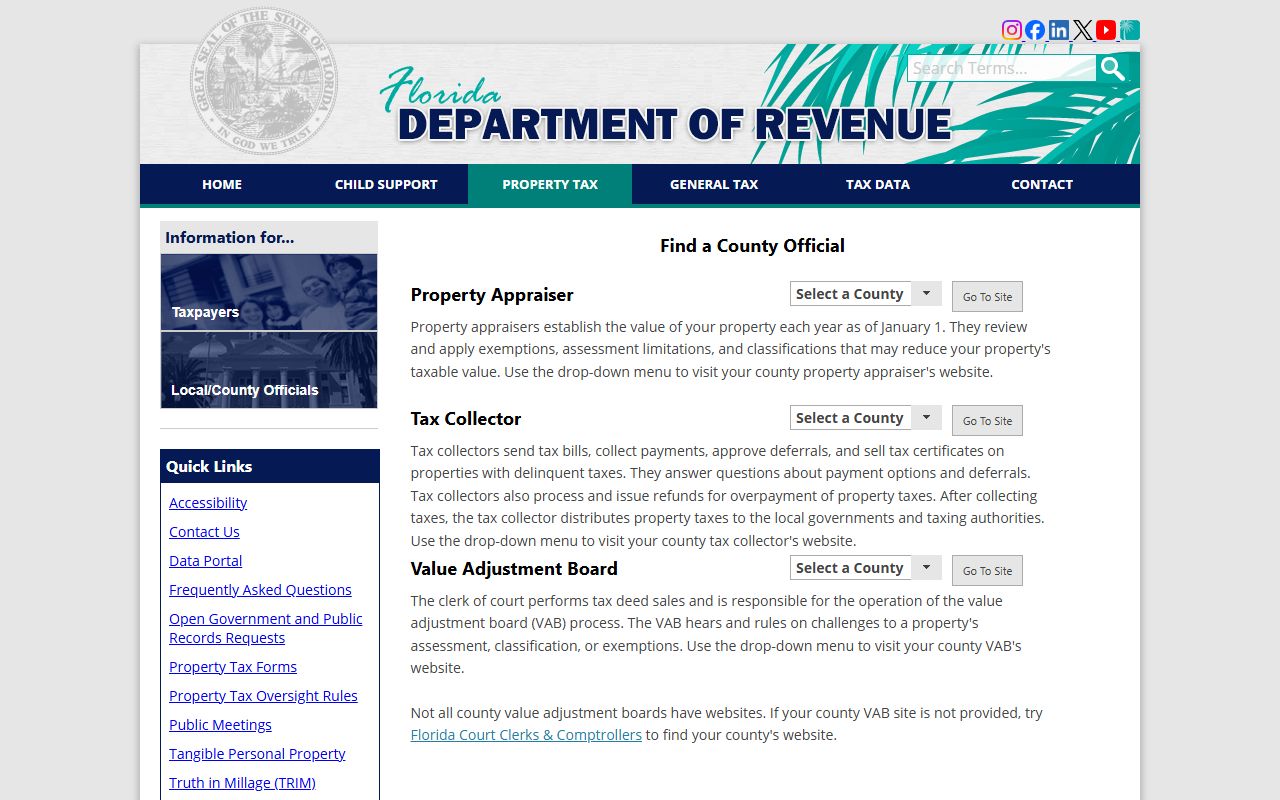
Use the DOR directory to confirm current contact information for the St. Lucie County offices before calling or visiting in Fort Pierce.
Tax Collector
The St. Lucie County Tax Collector's mailing address is P.O. Box 308, Fort Pierce, FL 34954-0308. Phone: (772) 462-1650. Fax: (772) 462-1968. The collector handles billing, payment processing, and enforcement for all Port St. Lucie property taxes. Tax bills go out in November each year. Pay in November for a 4% discount, December for 3%, January for 2%, and February for 1%. Taxes paid after March 31 are delinquent.
Delinquent taxes lead to a tax certificate sale held in June under Chapter 197, Florida Statutes. Investors bid at that sale and pay the overdue taxes. They earn interest. The property owner can pay off the certificate at any time before a tax deed is applied for. If two years pass without redemption, the investor may start the tax deed process, which can lead to the property being sold at public auction.
Online payment is available through the collector's website. You can pay by credit card or e-check. In-person service is available at the main Fort Pierce office and at branch locations. Check the collector's website for the nearest location to Port St. Lucie.
For owners who prefer quarterly payments, the installment plan option is available. Enroll before May 1 each year. Payments fall in June, September, December, and March. There's a small service charge for the plan. It doesn't save you money overall, but it spreads the cost evenly. Low-income senior homeowners should also ask about deferral options - Florida law allows eligible seniors to delay payment until the property is sold or transferred.
How to Search Port St. Lucie Property Tax Records
The St. Lucie County Property Appraiser's website is the primary tool for searching Port St. Lucie property records. Enter an address, owner name, or parcel ID in the search box. The result gives you the full parcel record: assessed value, taxable value, exemptions, land data, building data, and sales history. The search is free and does not require registration.
For tax billing data, use the Tax Collector's separate portal. Enter the parcel ID or address to see the current balance due, any discount deadlines, and the payment history. If a tax certificate has been issued on the property, that information will appear in the collector's system.
All Port St. Lucie property tax records are public under Chapter 119, Florida Statutes. You don't need to be a Florida resident to access them. No reason is required. The only protected data is personal information - Social Security numbers, bank account details - specifically shielded by Florida law. The rest is open.
For bulk data, the Florida DOR data portal provides county-level downloadable files. For individual parcel research, the county's own search tools are faster and more detailed. In-person requests are handled at the Property Appraiser's office at 2300 Virginia Avenue in Fort Pierce.
Researchers and buyers looking at multiple properties in Port St. Lucie often find it helpful to note the parcel IDs from the appraiser's search, then cross-reference billing data on the Tax Collector's site. The two systems together give a complete picture of any property's tax status.
The Florida DOR contact page is the right place to turn if the St. Lucie County offices can't resolve your Port St. Lucie property tax question.
The DOR can clarify statewide rules when county-level guidance on Port St. Lucie property taxes isn't enough.
Exemptions in Port St. Lucie
Florida exemptions apply fully to Port St. Lucie properties. The homestead exemption is the most used. It removes up to $50,000 from the assessed value of a primary residence. Apply at the St. Lucie County Property Appraiser's office in Fort Pierce by March 1 of the tax year. You'll need a Florida driver's license or ID showing the Port St. Lucie address, and your vehicle registration if you own a vehicle. The exemption rules are in Chapter 196, Florida Statutes.
Once homestead is granted, the Save Our Homes cap kicks in the following year. Annual assessed value increases are capped at 3% or the rate of inflation - whichever is lower. This cap is permanent for the property as long as you own it and maintain the homestead. When you sell and the new owner takes over, the cap resets. This is why two similar homes on the same street can have very different assessed values if one has been homesteaded for years and the other recently sold.
Portability lets you move your accumulated SOH benefit to a new Florida home. If you sell your Port St. Lucie home and buy another Florida property within two years, apply for portability at the new property's appraiser when you apply for homestead. This can transfer a meaningful chunk of your tax savings to the new location.
Other exemptions available include the senior low-income exemption, veteran and disability exemptions, and surviving spouse exemptions. Business owners with tangible personal property must file a return with the appraiser by April 1 to claim the $25,000 TPP exemption each year.
VAB Appeals
Port St. Lucie property owners who disagree with their assessment can file a petition with the St. Lucie County Value Adjustment Board. The 25-day filing window opens when TRIM notices go out each August. File before the deadline shown on your TRIM notice. Late filings are denied without a hearing. VAB procedures are governed by Chapter 194, Florida Statutes.
Petitions are heard by special magistrates who review the evidence from both the property owner and the appraiser. Good evidence includes comparable sales from the same neighborhood in the same time period, photos of condition problems, documentation of needed repairs, and an independent appraisal if you have one. The magistrate makes a recommendation, and the VAB votes on it. If you lose at the VAB level, you can file suit in circuit court as a final step.
Pay the non-disputed portion of your tax bill while the appeal is active. Failure to pay on time can lead to a tax certificate being issued even while the appeal is pending. The filing fee for a VAB petition is small and varies by property type. Most homeowners handle the filing themselves without an attorney.