
Search Santa Rosa County Property Tax Records
Santa Rosa County property tax records are public documents maintained by the Property Appraiser and Tax Collector offices, both located at 6495 Caroline Street in Milton. These records cover all parcels in the county and include assessed values, ownership data, exemption status, and tax payment history. This page explains how the county's property tax system works, how to find records, and what property owners can do about exemptions and assessment appeals.
Santa Rosa County Quick Facts
Santa Rosa County Property Appraiser
The Santa Rosa County Property Appraiser's office is at 6495 Caroline Street, Suite E, Milton, FL 32570. Phone: (850) 983-1800. Fax: (850) 623-8655. The appraiser is an elected official responsible for valuing all real and personal property in the county as of January 1 each year. That value is the foundation for the annual tax bill. The appraiser does not collect taxes and does not set millage rates, those are separate functions handled by the Tax Collector and the county's taxing authorities.
Santa Rosa County's property mix spans residential neighborhoods in communities like Gulf Breeze, Navarre, and Milton, along with rural land, agricultural parcels, and commercial property in the Pensacola metro area. The appraiser's office maintains the official property roll listing every parcel with its legal description, owner of record, assessed value, taxable value, and any applied exemptions. Records are updated throughout the year as property sales close, building permits are issued, and ownership changes are recorded.
The office uses mass appraisal methods that follow Florida Department of Revenue standards. Values are based on comparable sales, property characteristics, and condition data. Under Chapter 192, Florida Statutes, all Florida property must be assessed at just value each year. The DOR reviews each county's assessments annually to verify compliance with that standard.
The Florida Department of Revenue provides guidance on how the property tax system works at the DOR Property Tax Oversight page. Santa Rosa County's appraiser operates under the same statutory rules as every other Florida county. The DOR also oversees disputes between county appraisers and the state when aggregate assessment levels fall outside acceptable ranges.
The Florida DOR Property Tax Oversight page explains how all Florida counties, including Santa Rosa, assess and manage property tax records.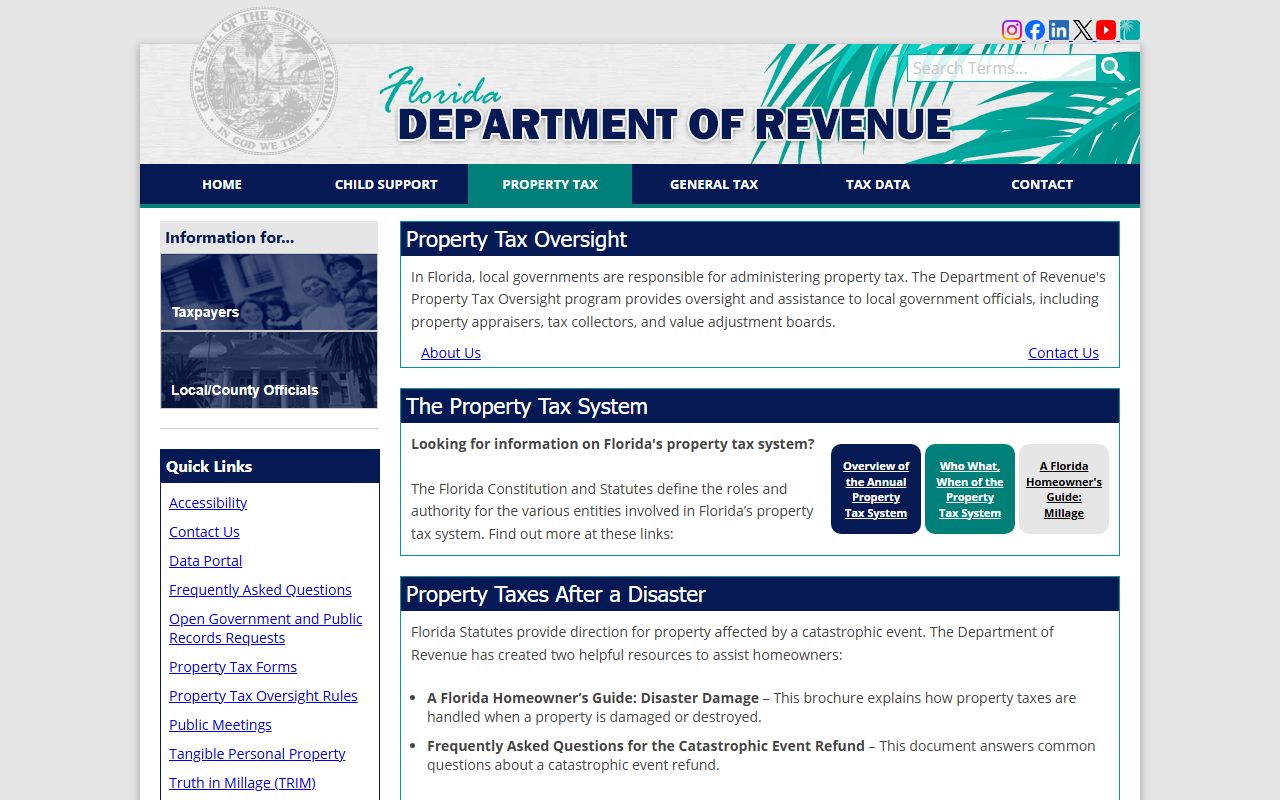
The DOR site is a useful reference for understanding how Florida's property tax system works and what standards all county appraisers must meet.
Note: Assessed value and just value can differ on homestead properties because the Save Our Homes cap limits annual increases in assessed value. The TRIM notice shows both figures. The difference is not an error, it reflects years of cap accumulation on long-held homestead properties.
Tax Billing and Collection in Santa Rosa County
The Santa Rosa County Tax Collector shares an address with the Property Appraiser: 6495 Caroline Street, Suite E, Milton, FL 32570. Phone: (850) 983-1800. Fax: (850) 623-8655. The Tax Collector is responsible for billing, processing payments, and enforcing property tax obligations for all parcels in the county. Tax bills go out in November each year, reflecting the taxable value from the property roll, adjusted for exemptions, multiplied by the combined millage rates from all relevant taxing authorities.
Florida's standard early payment discount schedule applies. Pay in November and receive 4% off the face amount of the bill. December earns 3%, January earns 2%, and February earns 1%. The full amount is due by March 31. After that date, taxes are delinquent and interest begins to accrue. The delinquent tax collection process is governed by Chapter 197, Florida Statutes. A tax certificate sale is held each June, at which investors can bid on delinquent parcels.
When an investor buys a tax certificate, they pay the outstanding taxes and receive a certificate that earns interest. The property owner then has up to two years to redeem the certificate by paying the taxes plus interest. If the owner does not redeem, the certificate holder can apply for a tax deed. This begins a process that can lead to a public sale of the property. Staying current on taxes, or enrolling in the installment plan, prevents this chain of events entirely.
The Florida Counties Association provides background on how Florida's county tax systems operate. You can find statewide context on county property tax administration at fl-counties.com.
The Florida Counties Association website covers how county-level property tax systems operate across Florida, including Santa Rosa County.
The association's site provides context on how Florida's decentralized property tax system works at the county level.
How to Search Santa Rosa County Property Tax Records
Contact the Santa Rosa County Property Appraiser's office directly at (850) 983-1800 to search parcel records or ask about online tools available for the county. The appraiser can provide parcel data including assessed values, ownership, exemption status, and sales history. In-person access is available at the office at 6495 Caroline Street, Suite E, Milton, FL 32570.
For broader research, the Florida DOR data portal provides downloadable property tax files for all 67 Florida counties, including Santa Rosa. These files are useful for bulk data analysis or for comparing Santa Rosa County data with neighboring counties. The portal is free and updated annually.
All Santa Rosa County property tax records are public under Chapter 119, Florida Statutes. You do not need to be a Florida resident, and you do not need to explain why you want the records. The core data, ownership, assessed values, tax amounts, payment history, is fully open. Some personal information on exemption applications is protected, but the main property and tax records are accessible to the public without restriction.
Property Tax Exemptions in Santa Rosa County
Florida exemptions apply to qualifying parcels in Santa Rosa County. Homestead is the most common. A primary residence can have its assessed value reduced by up to $50,000. The first $25,000 applies to all taxing authorities. The second $25,000 applies to assessed value between $50,000 and $75,000 and covers all taxing authorities except the school board. Applications must be filed by March 1 of the tax year.
Homestead also activates the Save Our Homes cap. Once homestead is in place, the annual increase in a property's assessed value is capped at 3% or the prior year's rate of inflation, whichever is lower. This cap is established in Chapter 193, Florida Statutes. In Santa Rosa County, where home values have grown substantially in recent years, the cap can create a significant gap between just value and assessed value for long-term homeowners. That gap translates directly into lower taxable value and a lower tax bill. When a property sells, the cap resets to the current just value for the new owner.
Other exemptions available in Santa Rosa County include the senior low-income exemption for residents over 65 who meet income thresholds, veteran exemptions, disability exemptions, and the widow/widower exemption. Each has its own application requirements and deadlines. All applications are filed with the Property Appraiser's office. The full framework for Florida property tax exemptions is set out in Chapter 196, Florida Statutes.
Business owners in Santa Rosa County with tangible personal property used in operations must file a TPP return with the appraiser by April 1. Filing on time preserves the $25,000 TPP exemption. Missing the April 1 deadline results in a penalty and forfeiture of the exemption for that year. The return is filed with the appraiser, not the Tax Collector.
Note: If you are moving your homestead from one Florida property to another, ask the appraiser's office about portability. You may be able to transfer up to $500,000 of your existing SOH benefit to the new property, which can meaningfully reduce your starting taxable value at the new home.
Appealing Your Santa Rosa County Assessment
Each summer, the Property Appraiser mails a TRIM notice to every property owner in Santa Rosa County. The notice shows the proposed assessed value for the upcoming tax year and the estimated tax impact. You have 25 days from the mailing of the TRIM notice to file a petition with the Value Adjustment Board if you think the value is too high.
Start by calling the appraiser's office. Bring evidence, comparable sales from nearby properties that closed before January 1 of the tax year, photos of any condition problems, or an independent appraisal. If the appraiser's data includes errors, wrong property size, wrong condition rating, or inappropriate comparables, the office may correct the value informally. This is faster than a formal VAB hearing and is the right first step for most property owners.
If the informal step doesn't resolve the dispute, file a VAB petition. A special magistrate will review your evidence and the appraiser's evidence and make a recommendation. The full appeals process is governed by Chapter 194, Florida Statutes. The board votes on the magistrate's recommendation. If the result still doesn't go your way, circuit court remains an option, though most cases resolve before that step. You do not need an attorney for a VAB hearing, though larger commercial appeals often involve one.
Payment Options for Santa Rosa County Taxes
The Santa Rosa County Tax Collector accepts payment in person at the Milton office, by mail, and through online payment options where available. Mail checks to 6495 Caroline Street, Suite E, Milton, FL 32570. Contact the office at (850) 983-1800 for current online payment options and to confirm hours and branch locations if any.
The quarterly installment plan is available for property owners who prefer to pay throughout the year rather than in a lump sum in November. Sign up in the spring before the tax year begins. Payments come due in June, September, December, and March. Each installment earns a discount. The plan is open to all Santa Rosa County property owners.
After March 31, unpaid taxes are delinquent. Interest and penalties accrue. The June tax certificate sale follows. Investors pay the overdue taxes and receive certificates that earn interest. After two years without redemption, tax deed proceedings can begin. This outcome is entirely preventable by paying on time or enrolling in the installment plan before the spring deadline.
Santa Rosa County Property Records and Public Access
Under Chapter 119, Florida Statutes, Santa Rosa County property tax records are open to anyone who asks. Assessment rolls, tax rolls, ownership data, exemption filings, and payment history are all public. You do not need to be a county resident or a Florida resident. You do not need to explain your reason. The appraiser and collector offices handle record requests directly. Fees may apply for large data requests or certified copies. The records themselves are public by law and must be made available within a reasonable time.
Cities in Santa Rosa County
Santa Rosa County includes communities such as Milton, Gulf Breeze, Navarre, and Pace. None of these cities currently meet the 75,000-population threshold for a dedicated city page. All property in Santa Rosa County is assessed by the same County Property Appraiser and taxes are collected by the same Tax Collector, regardless of which city or community the parcel is in. Contact the Milton office for parcel-specific information on any property in the county.