
Dixie County Property Tax Records
Dixie County property tax records cover a rural stretch of Florida's Gulf Coast, from the Suwannee River mouth north through the Big Bend region. The Property Appraiser in Cross City values every parcel in the county each year, and the Tax Collector handles billing and payment. Whether you own a riverfront cabin, agricultural land, timbered acreage, or a home in Cross City or Horseshoe Beach, this page covers how to search Dixie County tax records, review assessments, understand exemptions, and manage your annual property tax bill.
Dixie County Quick Facts
Dixie County Property Appraiser
The Dixie County Property Appraiser is located at 214 N.E. 351 Hwy., Suite G, Cross City, FL 32628. Phone: (352) 498-1213. Fax: (352) 498-1259. The office's website is at dixiepa.com. The property appraiser is elected and operates independently from the county commission. Every parcel in Dixie County is assessed as of January 1 of each tax year, residential homes, commercial properties, timber tracts, agricultural land, and waterfront lots along the Gulf and the Suwannee River estuary.
Dixie County is one of Florida's smallest and most rural counties. Real estate transactions are infrequent compared to larger markets, and the types of property are varied, from small residential lots in Cross City to large managed timberlands and hunting tracts that cover thousands of acres. The appraiser's office must develop values for all of these property types using the same state-mandated methodology applied in every Florida county.
For rural and timber properties, agricultural or forest-use classification can significantly reduce the assessed value. If land qualifies under Florida's classified-use assessment rules, it is taxed on its productive agricultural or timber value rather than its potential market value. That is a meaningful protection for landowners who want to keep large tracts in productive use without facing tax bills based on development-level values.
The TRIM notice goes out each August. It shows the proposed assessed value, any exemptions applied, and the millage rates proposed by the county commission and school board. Review it when it arrives. If the value looks wrong, call the appraiser's office. Many issues are resolved before the tax roll is certified in October.
The Dixie County Property Appraiser's website at dixiepa.com provides public parcel search tools and assessment records for all county properties.

The site includes parcel data, ownership records, and assessment histories accessible by address, owner name, or parcel ID.
Dixie County Tax Collector
The Tax Collector's mailing address is P.O. Box 5040, Cross City, FL 32628. Phone: (352) 498-1213. Fax: (352) 498-1259. The collector is a separate elected official. Once the appraiser certifies the tax roll each October, the collector's office takes over billing and collection. Annual property tax bills go out by November 1. Payment is due by March 31 without penalty.
Florida's early-payment discount schedule applies in Dixie County. Pay in full in November for a 4% discount. December saves 3%. January gets you 2% off. February saves 1%. After March 31, no discount applies and the account becomes delinquent on April 1. For smaller counties like Dixie, where tax bills are often modest in absolute terms, even the 4% discount can matter on tighter budgets.
The Tax Collector also processes motor vehicle registrations, driver license renewals, and hunting and fishing licenses. For property tax matters, the collector handles billing, payment processing, installment plan enrollment, tax certificate issuance on delinquent accounts, and payment history records. Questions about value go to the Property Appraiser. Questions about how much is owed and whether a bill has been paid go to the Tax Collector.
Note: In small counties, the same phone number often serves multiple offices. Confirm you are speaking with the right office, Appraiser or Collector, before asking your question.
How to Search Dixie County Property Tax Records
Start with the Property Appraiser's website at dixiepa.com. Parcel searches can use owner name, property address, or parcel identification number. In a county with many rural addresses and postal routes, the parcel number is often the most reliable search key. You can find the parcel number on a prior tax bill, a deed, or a title insurance policy.
Each record shows the current owner, mailing address, property use code, land value, improvement value, total assessed value, applied exemptions, and the legal description. For rural and timber parcels, the property use code tells you how the appraiser is classifying the land. Sales history is included when the property has sold in recent years. In Dixie County, some parcels may have limited comparable sales data given the low volume of transactions countywide.
For tax payment data, check with the Tax Collector's office by phone at (352) 498-1213 or online if the collector's system offers web search. The collector can confirm whether a bill has been paid, the amount outstanding, and whether a tax certificate has been issued. All Dixie County property tax records are public under Chapter 119, Florida Statutes. No reason is needed to access them.
The Florida DOR's data portal at floridarevenue.com/property/Pages/DataPortal.aspx provides downloadable bulk data files for Dixie County and all other Florida counties.
Property Tax Exemptions in Dixie County
Dixie County residents who own and occupy their home as a primary Florida residence can apply for the homestead exemption. File with the Property Appraiser by March 1. The exemption removes up to $50,000 from the assessed value used to calculate taxes. The first $25,000 applies to all taxing bodies, including the school board. The second $25,000 applies to non-school taxes only, and only on property assessed between $50,000 and $75,000.
Homestead status also activates the Save Our Homes cap under Chapter 193, Florida Statutes. Your assessed value can only rise by 3% or the Consumer Price Index change per year, whichever is lower. In a county where real estate prices have been increasing, this cap holds down assessed values for long-term homeowners even as the market moves up. If you sell and buy another Florida primary home, portability lets you transfer the accumulated SOH benefit to the new property.
For timber and agricultural land, the classified-use assessment is the most impactful tax break available. Land that is actively used for timber production, cattle grazing, or other qualifying agricultural activities can be assessed at a fraction of its market value. The property owner must apply for this classification through the Property Appraiser's office and demonstrate active agricultural or timber use. If the use changes, if land is cleared and developed, the classification is lost and back taxes may apply.
Other exemptions available in Dixie County include veteran disability, total and permanent disability, widow and widower, and the deployed military exemption. Business tangible personal property returns are due April 1. See Chapter 196, Florida Statutes for the full list of Florida property tax exemptions and eligibility rules.
Appealing Your Dixie County Assessment
When your August TRIM notice shows a value that seems wrong, call the Dixie County Property Appraiser's office at (352) 498-1213. In a small county office, getting a direct conversation with staff is often more accessible than in large metro offices. Bring your evidence: comparable sales, a private appraisal, or documentation of any error in the property record. Data corrections happen quickly. Value disagreements may need a formal challenge.
If the informal discussion does not produce an agreement, file a petition with the Value Adjustment Board within 25 days of the TRIM mailing date. The VAB hearing assigns a special magistrate to your case. You present your evidence. The appraiser presents the office's position. The magistrate makes a recommendation to the full board, which issues a final decision.
For agricultural and timber land, an appeal often turns on whether the land qualifies for classified-use assessment and what comparable agricultural rents or per-acre values support. Gather that data before your hearing. For residential properties, recent comparable sales from the area near January 1 of the tax year are the strongest evidence. Chapter 194, Florida Statutes governs VAB procedures and property owner rights in Florida.
Pay your taxes on time even with a VAB petition pending. Winning the appeal can earn a refund. Failing to pay on time creates a separate delinquency problem that the appeal does not resolve.
Paying Dixie County Property Taxes
Bills go out November 1. The full amount is due March 31. Florida's discount schedule rewards early payment: 4% off in November, 3% in December, 2% in January, 1% in February. Nothing after March 31. Delinquency starts April 1. In Dixie County, where many parcels are rural land and vacation properties, some owners manage taxes from out of state. If that describes you, make sure you are getting tax bills at the correct mailing address on file with the Tax Collector.
Payment options include in-person at the Tax Collector's office in Cross City, by mail, and potentially online depending on the current payment systems in place. Call (352) 498-1213 to confirm current online payment availability. The Florida Tax Collectors Association at floridataxcollectors.com provides information about payment programs available statewide, including installment plan details. Apply for the installment plan by April 30 to split the annual bill into four quarterly payments.
Delinquent accounts go to tax certificate sale each spring. Investors bid on certificates covering the overdue taxes. They earn interest until the property owner redeems the certificate by paying back the investor plus interest. After two years without redemption, the certificate holder can apply for a tax deed and start proceedings that may result in a forced property sale. Chapter 197, Florida Statutes covers the full delinquency, certificate sale, and tax deed process.
Dixie County Property Records and Public Access
Dixie County property tax records are public under Chapter 119, Florida Statutes. Assessed values, ownership information, parcel descriptions, sales histories, exemption types, and payment records are all open to the public. No account or stated purpose is required to access these records. They are presumed open unless a specific statutory exemption applies.
Confidential information includes Social Security numbers, personal income data, financial documents submitted to qualify for exemptions, and bank account or payment details. The record confirms whether an exemption is in place and what type it is, but the supporting financial documents used to qualify are protected from public disclosure.
To access Dixie County records, use the appraiser's online database at dixiepa.com, call or visit the offices in Cross City, or submit a written public records request. The Florida Department of Revenue's statewide FAQ answers common public access questions at floridarevenue.com. The Professional Association of Florida Appraisers at paaf.us offers additional context on how Florida's county appraisal system is structured and regulated.
The Florida Department of Revenue maintains a public records request process for state-level property data and tax information at floridarevenue.com.
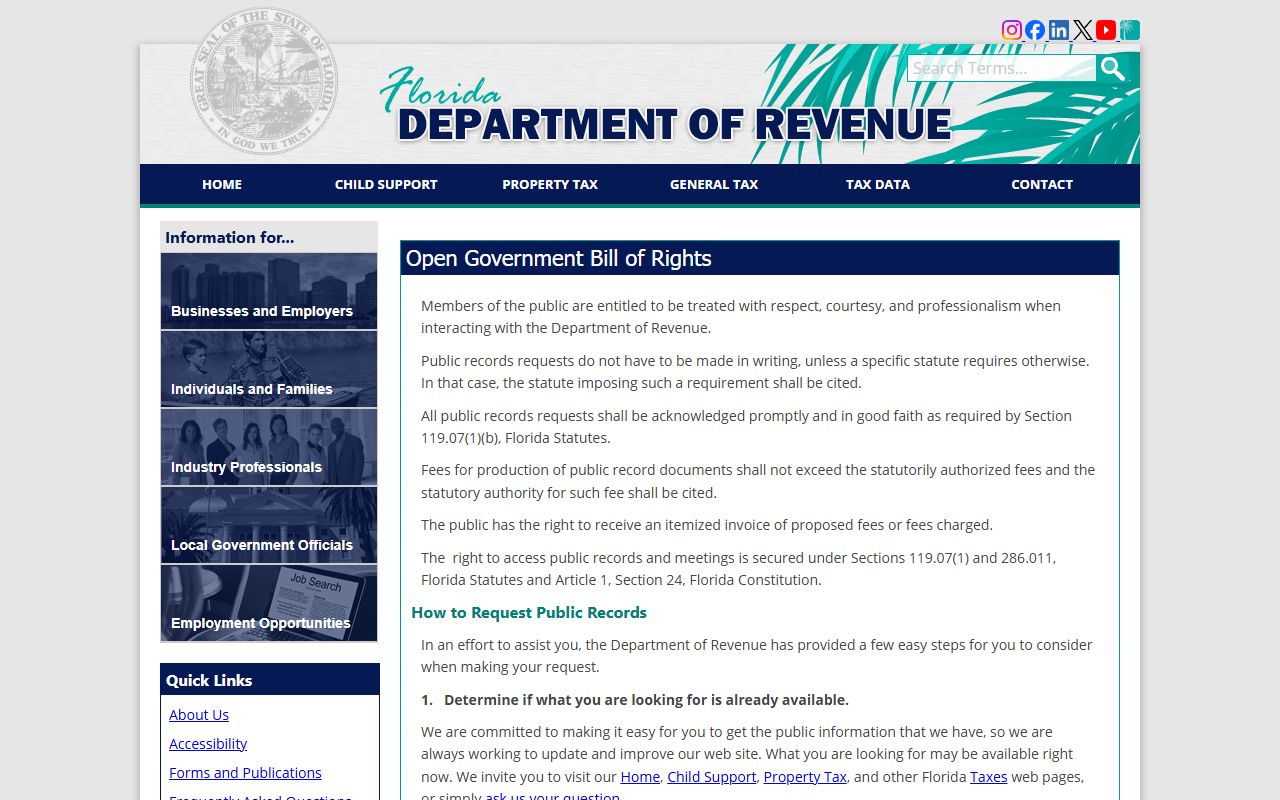
For records held at the state level, rather than the county level, the DOR's public records process is the correct starting point.
Cities in Dixie County
Dixie County is one of Florida's smallest counties by population. Cross City is the county seat and its largest incorporated community. Other settlements include Horseshoe Beach, Old Town, and Suwannee on the Gulf Coast. None of these communities approach the 75,000-resident threshold for a dedicated city page. All property tax records for Dixie County, including Cross City and coastal properties, are managed through the county-level offices in Cross City.