
Access Orlando Property Tax Records
Orlando property tax records are public documents managed by the Orange County Property Appraiser and Tax Collector. These records include assessed values, ownership data, exemptions, and tax bill history for every parcel within city limits. This page covers where to search, what you'll find, and how to deal with exemptions, appeals, and payments specific to Orlando.
Orlando Quick Facts
Property Tax in Orlando
Orlando is the county seat of Orange County, and property tax functions are handled at the county level. The Orange County Property Appraiser values every parcel in Orlando as of January 1 each year. The Orange County Tax Collector handles billing and collects the taxes. The city of Orlando does not operate its own appraiser or collector.
Orlando's growth has pushed property values higher in recent years. The metro area has attracted substantial new development - residential, commercial, and mixed-use. That growth means assessed values have climbed in many neighborhoods. New property owners see assessments that closely track their purchase price. Long-time homestead holders are protected by the Save Our Homes cap, which holds annual increases to 3% or the rate of inflation.
Several taxing authorities levy against Orlando parcels. The county, the school board, the City of Orlando, the South Florida Water Management District, and several special improvement districts all set their own millage rates. The TRIM notice you receive each August shows each authority and its proposed millage. The total tax bill adds them all up and applies the sum to your taxable value.
The Florida Department of Revenue Property Tax Oversight program sets the standards that Orange County must meet. The DOR reviews and certifies the county's assessment roll annually. The base assessment standard - just value - is defined in Chapter 192, Florida Statutes.
Orange County Property Appraiser
The Orange County Property Appraiser's office is at 200 S. Orange Ave., Suite 1700, Orlando, FL 32801. Phone: (407) 836-5044. Fax: (407) 836-5944. The Orange County Property Appraiser website is where you search parcel records. The search tool accepts an address, owner name, or parcel ID. Results show the full property record including assessed value, taxable value, exemptions, and sales history.
Orange County's property roll covers a huge range of property types. Orlando's downtown core includes high-rises, hotels, and commercial towers. Surrounding neighborhoods have single-family homes, townhouses, and condominiums. The appraiser's office applies different valuation methods to each type, using comparable sales for residential properties, income capitalization for hotels and commercial properties, and cost approaches for specialized buildings like schools or industrial facilities.
The appraiser's records include not just the assessed value but also the property's physical characteristics: lot size, year built, building square footage, number of rooms, construction type, and roof type. This data feeds into the mass appraisal model. If the data is wrong - for example, if the appraiser has the wrong square footage on file - correcting it can lower your assessment. You can request a data review by contacting the office directly.
The Florida DOR directory lists all county appraisers statewide, including the Orange County office, with current phone numbers and addresses.
The Florida DOR Find County Officials page lists contact information for the Orange County Property Appraiser and Tax Collector who serve Orlando.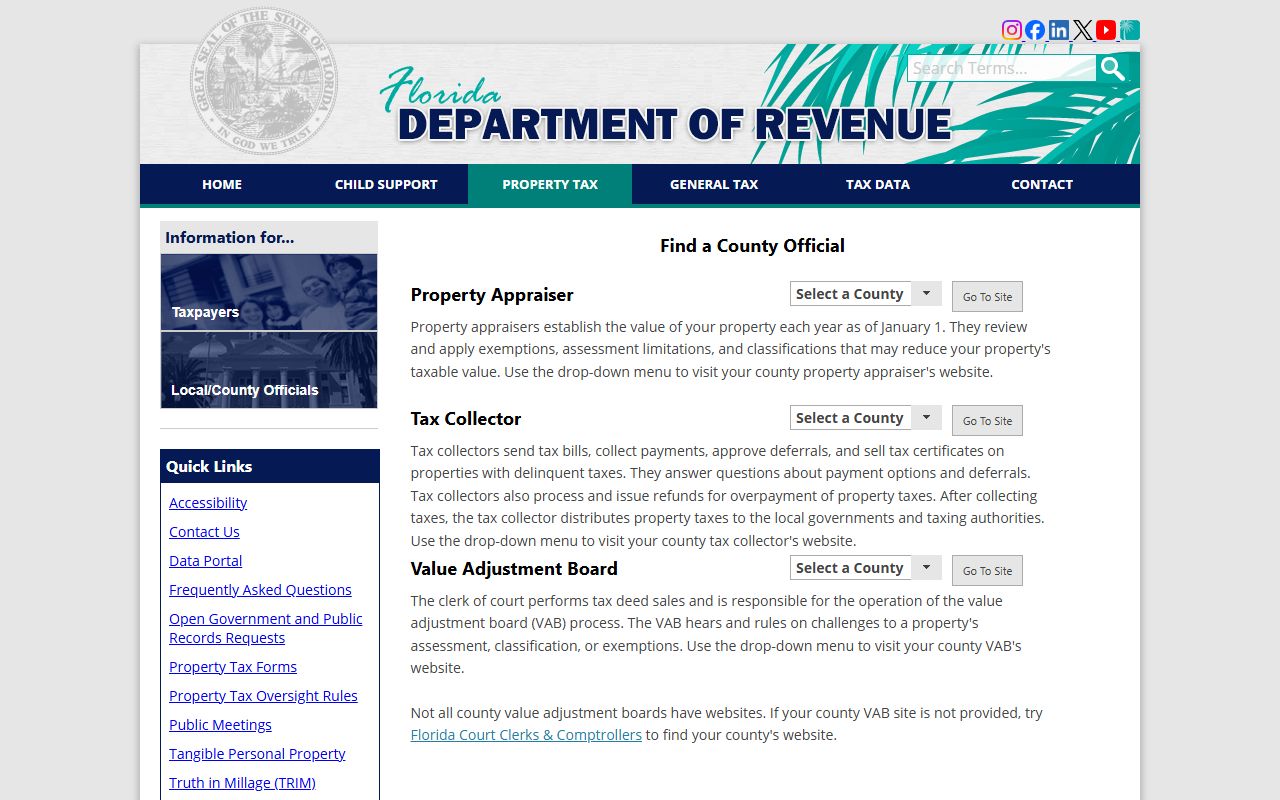
Use the DOR directory to confirm office details before making a trip to the Orange County offices in downtown Orlando.
Tax Collector
The Orange County Tax Collector's mailing address is P.O. Box 545100, Orlando, FL 32854. Phone: (407) 845-6200. Fax: (407) 254-1074. The collector's office handles billing and payment for all property taxes in Orange County. Branch locations are available across the county - check the collector's website for office addresses and hours closest to your property.
Bills go out in November. The payment schedule is the same as the rest of Florida: 4% discount in November, 3% in December, 2% in January, 1% in February. After March 31, taxes are delinquent. The delinquency process is governed by Chapter 197, Florida Statutes. A tax certificate sale is held in June each year for parcels with unpaid taxes.
Online payment is available through the collector's portal. The site accepts credit cards and electronic checks. You can also pay in person at any branch office. For owners who prefer to spread out their payments, the quarterly installment plan is available - enroll before May 1 each year. The first installment is due in June, and subsequent ones follow in September, December, and March.
Property owners facing financial hardship should contact the collector's office. There are programs for low-income seniors that allow deferral of property taxes until the property is sold or transferred. The deferral accrues interest, but it avoids forced sale while the owner is alive and living in the home.
How to Search Orlando Property Tax Records
The Orange County Property Appraiser's website is the right starting point for most Orlando searches. Enter a street address or parcel ID to pull up the full record. The search is free. No account is needed. Once you have the record, you can view the map, check the sales history, and see the full breakdown of assessed versus taxable value.
For billing data, go to the Orange County Tax Collector's site and enter the same parcel ID. The billing system is separate from the appraiser's system. It shows the amount currently due, past payment history, and whether any certificates are outstanding on the parcel.
Florida's public records law - Chapter 119, Florida Statutes - makes all of this data open to anyone, with no residency requirement and no need to explain your purpose. The only protected data is specific personal information on exemption applications, like Social Security numbers.
Researchers who need bulk data can use the Florida DOR data portal. It provides downloadable summary files at the county level that are useful for market analysis and investment research. For individual parcel lookups, the county's own tools are faster and more detailed.
In-person requests are accepted at 200 S. Orange Ave. in downtown Orlando. Staff can assist with questions that aren't resolved by the online tools. Certified copies of records may carry a small fee, but viewing data on-screen at the office is free.
The Florida DOR contact page directs you to the right office when you need state-level help with an Orlando property tax question.
The DOR contact page is useful when county staff are not able to resolve a dispute or answer a procedural question about Orlando property taxes.
Exemptions in Orlando
Florida's full range of exemptions applies to Orlando properties. The homestead exemption is the most important. It reduces the assessed value of your primary residence by up to $50,000. Apply at the Orange County Property Appraiser's office by March 1 of the tax year. Bring your Florida ID, proof that Orlando is your primary address, and your vehicle registration if you own a car. Once approved, the exemption renews automatically as long as you remain the owner and the property is your primary home. The rules governing exemptions are in Chapter 196, Florida Statutes.
Homestead status also turns on the Save Our Homes cap. After the first year of exemption, annual increases in assessed value are capped at 3% or the prior year's inflation rate - whichever is lower. Given how fast Orlando's market has moved, this cap represents real savings for owners who have held their homes for several years. When the property sells, the cap resets to just value for the new owner in the next assessment cycle.
Portability lets homestead owners in Florida transfer their accumulated SOH benefit to a new primary home. If you sell your Orlando home and buy another Florida property within two years, you may be able to carry part of your tax savings with you. The portability application goes to the Property Appraiser's office. Ask the office for the portability form and instructions when you close on your new home.
Other available exemptions include the senior low-income exemption, veteran and disability exemptions, and surviving spouse exemptions. Tangible personal property exemptions apply to businesses. The $25,000 TPP exemption requires an annual return filed with the appraiser by April 1.
VAB Appeals
Orange County has a Value Adjustment Board that hears appeals from Orlando property owners who disagree with their assessed values. The 25-day filing window opens when TRIM notices go out each August. File your petition before the deadline shown on your TRIM notice. Late petitions are rejected without a hearing.
Hearings are conducted by special magistrates. You present your evidence and the Property Appraiser presents theirs. Relevant evidence includes comparable sales in your neighborhood from the same time period, data showing errors in your property record, photos of condition problems, and an independent appraisal if you have one. The magistrate makes a recommendation; the VAB votes to accept or reject it. The process is set out in Chapter 194, Florida Statutes.
If the VAB does not rule in your favor, circuit court is the next step. Most owners settle before that point. Pay the non-disputed portion of your bill while the appeal is in progress. Failure to pay can lead to delinquency costs even if your appeal is eventually successful.