
Miramar Property Tax Records Search
Miramar property tax records are public documents maintained by the Broward County Property Appraiser and the Broward County Tax Collector. Miramar has a population of about 143,000 and sits in the southwestern part of Broward County, bordering Miami-Dade County to the south. Every parcel within Miramar city limits is assessed by Broward County. Tax bills are sent and collected by the Broward County Tax Collector. This page covers how to find records, apply for exemptions, challenge an assessment, and understand your rights under Florida public records law.
Miramar Quick Facts
Broward County Tax Administration for Miramar
Miramar is within Broward County. There is no separate city property tax office. The Broward County Property Appraiser assesses all Miramar parcels. The Broward County Tax Collector bills and collects those taxes. Both are elected county offices that work independently from each other and from the city.
Miramar is a large suburban city with a substantial residential base. Single-family homes, townhomes, and planned communities make up much of the city. There are also commercial and industrial areas, particularly near the Turnpike corridor. The appraiser values all property types using mass appraisal methods based on comparable sales and property data. All values are set as of January 1. Any sale or change after that date does not affect the current year's assessment. This rule comes from Chapter 192, Florida Statutes.
For a full overview of Broward County property tax procedures, see the Broward County property tax records page.
Broward County Property Appraiser
The Broward County Property Appraiser is at 115 S. Andrews Ave., Room 111, Fort Lauderdale, FL 33301. Phone: (954) 357-6830. The office is open Monday through Friday, 8 a.m. to 5 p.m. The appraiser values every parcel in Broward County, including all Miramar properties, as of January 1 each year.
The property roll is the official record of all Broward County parcels. Each Miramar parcel has an entry with its legal description, owner of record, just value, assessed value, taxable value, and any active exemptions. Records update through the year as deeds record and permits are issued. The appraiser does not collect taxes and does not set millage rates.
The Broward County Property Appraiser website provides free online access to all parcel data. You can search any Miramar property by owner name, address, or parcel ID. Results show current assessed values, prior-year data, exemptions, building and land characteristics, and sales history. The site also includes map and aerial views of each parcel.
The appraiser site offers two additional tools at no cost. The homestead exemption e-file portal at bcpa.net/onlinehomestead.asp lets you apply without visiting the office. The Owner Alert service at the Owner Alert page notifies you if any document is recorded against your Miramar property, a useful tool for catching unauthorized transfers or fraudulent deeds.
The Florida Department of Revenue sets the standards all county appraisers must meet. The DOR Property Tax Oversight page explains how the statewide assessment system works. Assessment rules are also set out in Chapter 193, Florida Statutes.
The Florida DOR Property Tax Oversight page explains the assessment rules Broward County follows for Miramar parcels.
The DOR oversees county appraisers statewide, ensuring consistent valuation standards apply to every Miramar parcel.
Broward County Tax Collector
The Broward County Tax Collector's main office is at 1800 NW 66th Ave., Suite 100, Plantation, FL 33313. Phone: (954) 765-4697. The collector sends tax bills in November for all Miramar properties and processes all payments.
Miramar tax bills reflect the taxable value set by the appraiser, multiplied by millage rates from several authorities: Broward County, the school board, the City of Miramar, and various special districts. Each body sets its own rate. The total bill combines all of them. You pay one bill covering all taxing authorities.
Pay in November for a 4% discount. December saves 3%, January 2%, February 1%. After March 31, taxes are delinquent and a 3% penalty applies. The collector schedules a tax certificate sale for all unpaid accounts. The certificate sale is governed by Chapter 197, Florida Statutes.
Online payment for Miramar property taxes is at browardtax.org. The site also has a parcel lookup showing current balances, payment history, and any outstanding certificates. Mail and in-person payments at branch offices are also accepted.
How to Search Miramar Property Tax Records
Start with the Broward County Property Appraiser's search portal. Enter a Miramar owner name, address, or parcel ID. Results include current just value, assessed value, taxable value, exemptions on file, building and land data, and recent sales. No account is needed and the search is free.
For tax billing information, use the Broward County Tax Collector's parcel lookup at browardtax.org. Enter the parcel ID or address to see current amounts owed, whether prior bills were paid, and whether any tax certificates are on file for the property. Together, the two portals give a complete picture of any Miramar parcel.
The Florida Department of Revenue maintains a statewide data portal with downloadable county-level property data. See the DOR Property Tax Data Portal for bulk data on Broward County including Miramar. The DOR FAQ page answers common questions about property tax records and how to access them.
All Miramar property tax records are public under Chapter 119, Florida Statutes. No ID or stated reason is required. Online portals are available 24 hours a day. For records not available online, contact either office directly. The appraiser and collector must respond to public records requests in a reasonable time.
The Florida DOR data portal gives researchers access to bulk Broward County data including Miramar property records.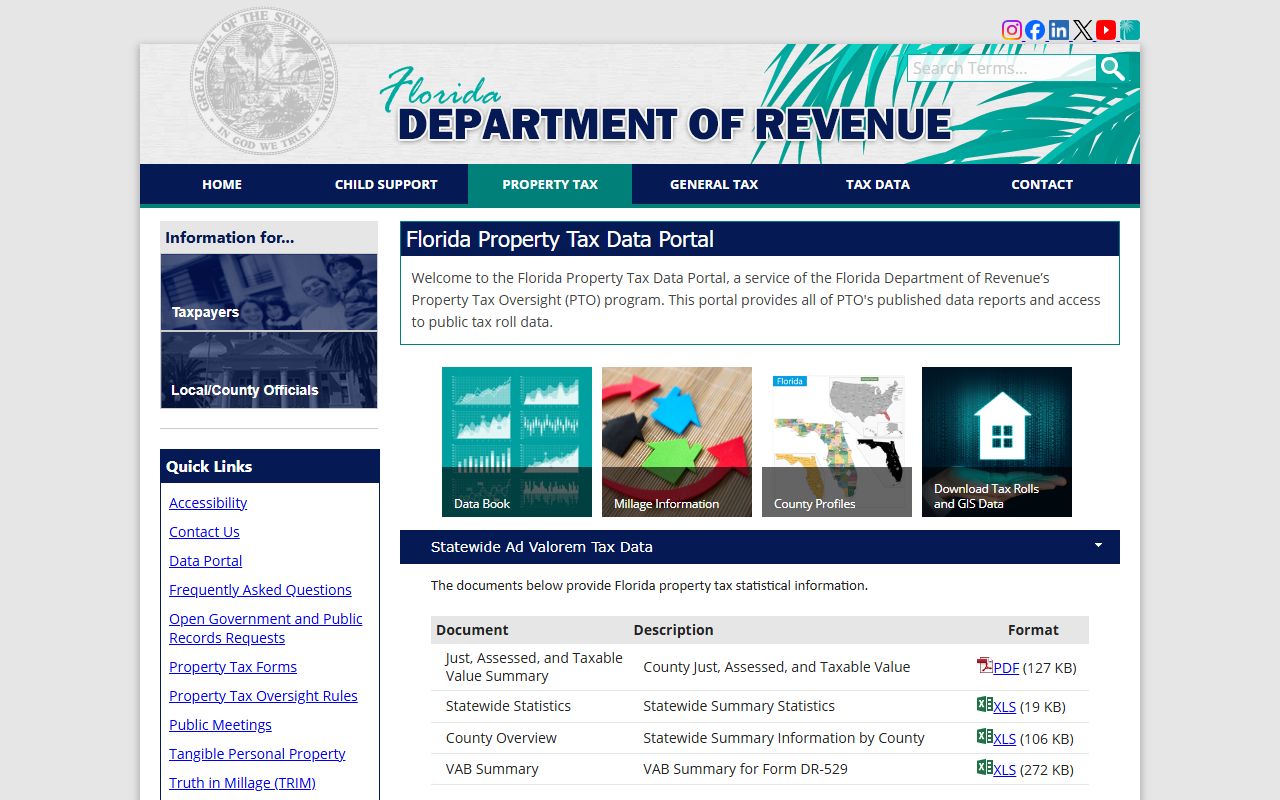
Researchers and investors can use the DOR data portal to download aggregate Broward County property tax data.
Exemptions for Miramar Property Owners
Miramar property owners who use their home as a primary residence can apply for the homestead exemption. This reduces assessed value by up to $50,000. The first $25,000 applies to all taxing authorities. The second $25,000 applies to the value range between $50,000 and $75,000 but does not apply to school taxes.
Homestead activates the Save Our Homes cap. Once in place, annual increases in assessed value are limited to 3% or the inflation rate, whichever is less. Miramar property values have risen steadily in recent years. For owners who have held homestead for several years, the cap can produce a large gap between just value and taxable value, cutting the tax bill noticeably.
Other Broward County exemptions include the senior low-income exemption for residents 65 and older, veteran and disability exemptions, and surviving spouse exemptions. File all exemption applications with the Broward County Property Appraiser by March 1 each year. See Chapter 196, Florida Statutes for full eligibility rules.
Business owners in Miramar with tangible personal property must file a TPP return with the appraiser by April 1. The first $25,000 of TPP value is exempt from taxation. Filing on time claims this exemption automatically. A late return forfeits the exemption and may result in a penalty assessment.
The Broward County Property Appraiser's site at bcpa.net has exemption forms, eligibility guides, and the online homestead filing portal. Staff can also help by phone at (954) 357-6830 during business hours.
Value Adjustment Board Appeals
Miramar property owners who believe their assessed value is too high can appeal to the Broward County Value Adjustment Board. Each summer, TRIM notices arrive from the appraiser showing the proposed assessed value and estimated taxes. You have 25 days from the TRIM mailing date to file a petition with the VAB.
The VAB process is governed by Chapter 194, Florida Statutes. After filing, you will be scheduled for a hearing before a special magistrate. Bring evidence: comparable sales from your Miramar neighborhood, photos showing any condition issues, and an independent appraisal if you have one. The burden is on you to show the appraiser's value is wrong.
Most Miramar residential owners handle VAB hearings on their own. Commercial property owners often bring tax professionals given the higher dollar amounts. Filing fees are modest. If the VAB rules against you, a circuit court lawsuit is still available, though most disputes settle at the board level.
While an appeal is open, pay at least the non-disputed portion of your bill. Failure to pay can result in penalties even if the appeal eventually succeeds. Early payment discounts still apply during the appeal period.
Payment and Delinquency
Broward County mails Miramar tax bills in November. The 4% discount window runs through November 30. December earns 3%, January 2%, February 1%. March 31 is the hard deadline. After that, a 3% penalty applies and the collector flags the account for the tax certificate sale.
Investors buy tax certificates at the sale for delinquent Miramar properties. The certificate earns interest. You can redeem it at any time by paying the taxes owed plus interest and costs. After two years without redemption, the certificate holder can apply for a tax deed. A tax deed auction could result in the loss of your Miramar property.
Payment options include online at browardtax.org, by mail, and at Broward County Tax Collector branch offices. A quarterly installment plan is available for taxpayers who prefer to pay in smaller amounts through the year. Sign-up for the installment plan opens in the spring before the tax year's bills are issued.
Public Records Access
Miramar property tax records are open to the public. Florida's public records law, Chapter 119, gives every person the right to inspect government records. You do not need to own Miramar property or be a Florida resident. You do not need to give a reason. The Broward County Property Appraiser and Tax Collector must provide access on request.
Online portals at bcpa.net and browardtax.org are free and available around the clock. For records not posted online, contact either office directly by phone or in writing. Staff may charge a modest fee for copies or large data exports, but access to the records themselves is a legal right. Owner names, assessed values, tax amounts, exemptions, and sales history are all fully public for every Miramar parcel. Some personal data on exemption applications is confidential, but core property records are completely open.