
Fort Myers Property Tax Records Lookup
Fort Myers property tax records are public documents managed by the Lee County Property Appraiser and Lee County Tax Collector, both of which maintain offices in Fort Myers as the county seat. These records include assessed values, ownership data, exemption status, and complete tax billing history for every parcel in the city. This guide shows you how to find what you need and what to do if you think your assessment is off.
Fort Myers Quick Facts
Lee County Property Tax Administration
Fort Myers is the county seat of Lee County, which means the main offices for property tax administration are located here. The Lee County Property Appraiser and the Lee County Tax Collector both operate in Fort Myers, giving city residents easy access to in-person services that residents of outlying communities sometimes have to travel for.
Lee County has a large and varied property roll. It includes single-family homes, condominiums, commercial buildings, agricultural land, and vacant parcels spread across Fort Myers and surrounding communities. The property appraiser values all of these as of January 1 each year. Values are set using mass appraisal methods that follow Florida Department of Revenue standards. Sales data, building permits, and property characteristics all factor into annual value updates. More on that methodology is available at the DOR Property Tax Oversight page.
Tax rates in Fort Myers come from multiple sources: Lee County general millage, the school board, the city of Fort Myers, the South Florida Water Management District, and other special purpose districts. Each sets its rate independently. Your bill is the sum of all applicable millage rates applied to your taxable value. The legal foundation for this system is Chapter 193 and Chapter 197, Florida Statutes.
Fort Myers has seen significant growth in recent years, which has pushed property values upward across much of the city. Homesteaded properties are partially shielded from large increases by the Save Our Homes cap, but non-homesteaded properties, including rentals and commercial buildings, can see larger annual value changes when the market moves.
Lee County Property Appraiser
The Lee County Property Appraiser office is at 2480 Thompson Street, Fort Myers, FL 33901. The main phone number is (239) 533-6100. This office is responsible for valuing all real and personal property in Lee County as of January 1 each year. The appraiser does not set tax rates and does not collect taxes. Those are separate functions.
The property appraiser maintains the official property roll for Lee County. Each parcel record includes the legal description, owner of record, just value, assessed value, taxable value, land data, building data, sales history, and any exemptions applied. You can search these records online through the Lee County Property Appraiser's website. Search by address, owner name, or parcel identification number. The search is free to the public.
The appraiser's office also provides GIS mapping tools. These show parcel boundaries, aerial imagery, and nearby comparable sales. This data is useful for owners who want to understand how their value compares to similar properties and for buyers doing due diligence before a purchase.
Assessment methodology follows Florida DOR rules. The DOR reviews the county's roll each year to confirm values fall within acceptable ranges. Under Chapter 193, Florida Statutes, all property must be assessed at just value, which in practice means market value for most property types.
The Florida DOR contact directory lists all county property appraiser offices, including Lee County in Fort Myers.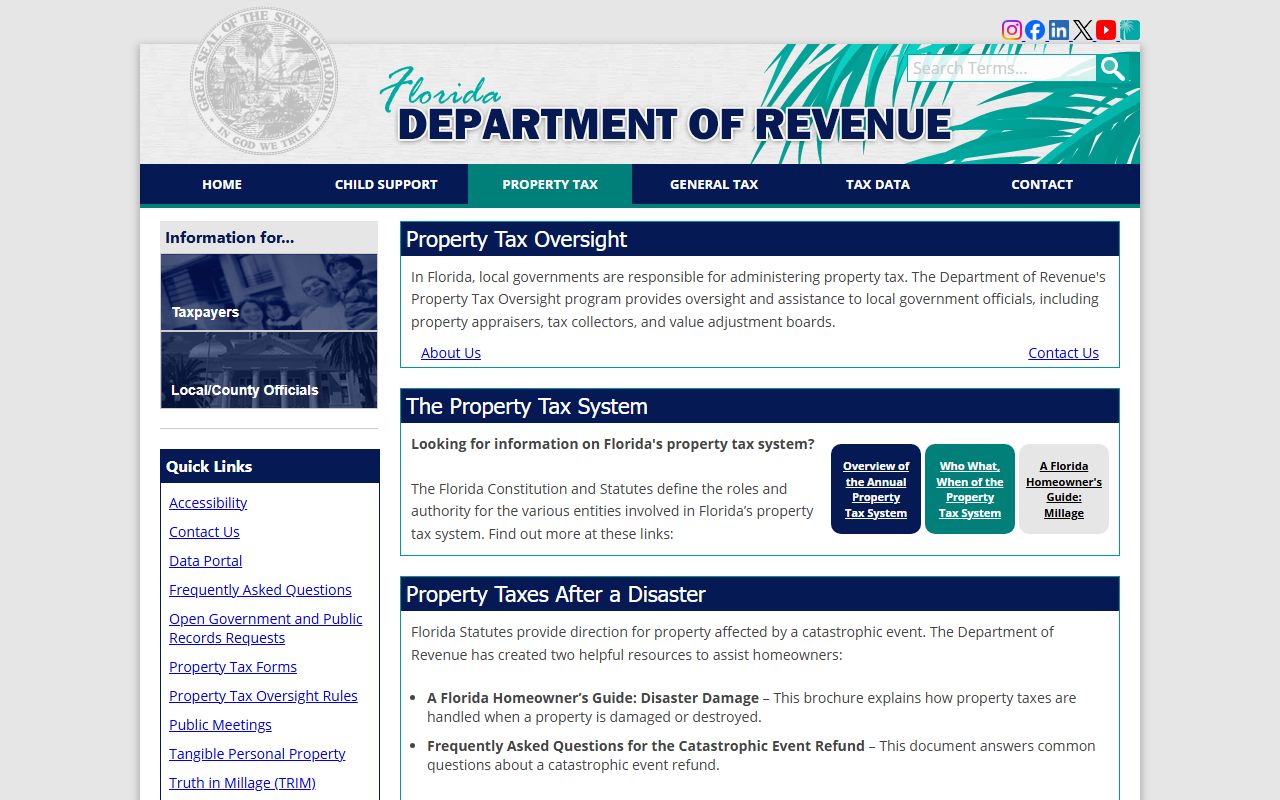
The DOR contact directory confirms current addresses and phone numbers for Lee County property tax offices.
Lee County Tax Collector
The Lee County Tax Collector also operates in Fort Myers. The collector handles billing, payment, and enforcement for all Lee County property taxes, including every parcel in Fort Myers. Contact information and office hours are available on the Lee County Tax Collector website.
Tax bills are mailed in November each year. The face amount is the full tax due without any discount. Florida's early payment discount schedule runs from November through February: 4% off in November, 3% in December, 2% in January, 1% in February. After March 31, taxes become delinquent under Chapter 197, Florida Statutes.
Payment options include online payment through the collector's website, mail, and in-person at the Fort Myers office and any satellite locations. An installment payment plan is available for those who want to spread their tax payments throughout the year. Enrollment opens in the spring before the tax year. Check the collector's site for current enrollment dates and requirements.
Delinquent taxes lead to a tax certificate sale in June. Investors pay the overdue tax and earn interest on the certificate. If the property owner does not redeem the certificate within two years, the investor can apply for a tax deed. This is a serious consequence that can result in the forced sale of a Fort Myers property. Paying on time, or at least staying current with the collector, prevents this outcome.
How to Search Fort Myers Property Tax Records
Start at the Lee County Property Appraiser's website. Enter the property address, owner name, or parcel ID. The result shows just value, assessed value, taxable value, exemptions, land data, building data, and recent sales. Free access. No login needed.
For billing data, go to the Lee County Tax Collector's site. Search by parcel ID or address to see the current balance, payment history, and prior-year bills. Together, these two databases answer almost any question about a Fort Myers parcel's tax status.
All property tax records are public under Chapter 119, Florida Statutes. You do not need to be a Lee County resident. You do not need a reason. Some exemption application data is confidential, but all core assessment and billing records are open. The Florida DOR also maintains a statewide property data portal with downloadable county files for bulk research use.
Standard Florida property tax forms are available on the DOR forms page, including homestead exemption applications for Fort Myers property owners.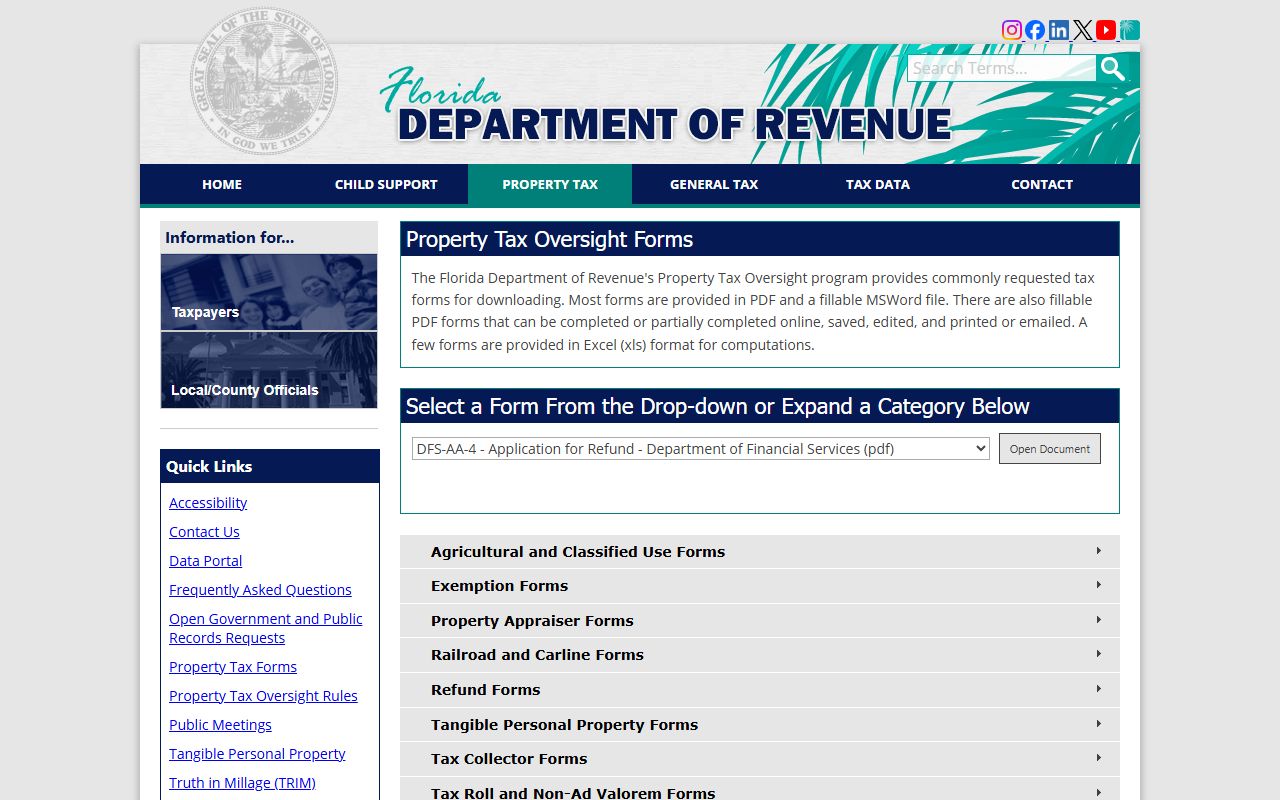
The DOR forms page is the best place to find current, official versions of all Florida property tax forms.
Property Tax Exemptions in Fort Myers
Florida exemptions apply to qualifying Fort Myers properties just as they do statewide. The homestead exemption is the most common. It removes up to $50,000 from the assessed value of a primary residence. The first $25,000 applies across all taxing authorities. The second $25,000 covers the value range from $50,000 to $75,000 and applies to everything except school taxes. On a homesteaded property in Fort Myers, this can save several hundred dollars per year.
Homestead triggers the Save Our Homes cap. This limits annual increases in assessed value to 3% or the rate of inflation, whichever is lower. In Fort Myers, where values have risen sharply in recent years, this cap has been a significant benefit for long-term homesteaded owners. Portability allows you to carry your accumulated SOH benefit to a new Florida home when you move and sell your Fort Myers property.
Other exemptions include the low-income senior exemption, disability exemptions, veteran exemptions, and the widow or widower exemption. Each requires an application to the Lee County Property Appraiser by March 1. Exemption rules are set out in Chapter 196, Florida Statutes. Business owners should file a tangible personal property return by April 1 to claim the $25,000 TPP exemption on business equipment and furnishings.
VAB Appeals in Fort Myers
Florida gives property owners a formal path to challenge their assessment. Each August, the Lee County Property Appraiser mails a TRIM (Truth in Millage) notice with the proposed assessed value. You have 25 days from that mailing to file a petition with the Lee County Value Adjustment Board.
The VAB operates independently of the appraiser. A special magistrate hears your case and reviews evidence from both sides. Good evidence includes comparable sales from nearby properties sold around January 1, photos documenting condition problems, or an independent appraisal. You carry the burden of showing the appraiser's value is wrong. The process is governed by Chapter 194, Florida Statutes. If the VAB does not rule your way, you can file suit in circuit court. Pay the non-disputed portion of your bill while the appeal is open to avoid delinquency charges.
Payment and Delinquency
Lee County tax bills go out in November. Pay by March 31 to avoid delinquency. The best deal is paying in November, when the 4% discount applies. Each month after that, the discount drops by one point. Delinquent parcels go into a tax certificate sale in June. Certificates left unpaid for two years allow the investor to seek a tax deed. Pay on time and none of this becomes a concern.
Online payment, mail payment, and in-person payment are all available through the Lee County Tax Collector. An installment plan is available for those who prefer spreading payments. Check the collector's site for current details. The Florida Tax Collectors Association also provides general payment guidance.
Public Records Access
Florida's public records law, Chapter 119, makes property tax records open to everyone. Assessment rolls, tax rolls, exemption files, and payment history are all public. No ID needed. No reason required. The Lee County Property Appraiser and Tax Collector websites handle most requests for free. For records not online, contact the offices directly. They may charge for staff time on large requests, but the records are public. For county-level details, see the Lee County property tax records page.